Claude Opus 5 Is Here: Features, Pricing, Benchmarks, and What It Means for AGI
Claude Opus 5 launched on July 24, 2026. Here are the confirmed features, prices, model identifiers, and Anthropic-reported benchmark results, plus an honest scorecard of my pre-release predictions.
By Muhamad J. Akoum Senior Product Engineer
- Claude
- Anthropic
- Opus 5
- AI models
- agentic coding
- AGI
Part of the Future Intelligence evidence cluster.
Evidence reviewed: Jul 30, 2026
Next review: Aug 29, 2026
Freshness: fast-moving · 30-day cadence
Primary question: claude opus 5
Editorial role: news
Update: the pre-release analysis is now a launch guide#
Correction, July 26, 2026: This page began as pre-release analysis. Anthropic launched Claude Opus 5 on July 24, so I rewrote the article from the ground up using confirmed launch information. I preserved the original URL and publication date for transparency, and scored my earlier predictions below.
Correction, July 30, 2026: I had described Opus 5 as Anthropic's most capable model and scored my "a differently named tier might remain above Opus" prediction as wrong. Both were my error. Claude Fable 5 has been generally available since June 9, 2026, six weeks before Opus 5 shipped, and Anthropic still describes Fable 5 as its most capable widely released model. I have corrected the opening, the scorecard, and the closing summary, and tightened the fast-mode description to match Anthropic's documented wording.
Claude Opus 5 is here. Anthropic released it on July 24, 2026 for complex coding, agents, research, and other long-running professional work. The API model ID is claude-opus-5.
It is not the top of Anthropic's lineup, and Anthropic does not claim it is. Claude Fable 5 has been generally available since June 9, 2026 and is still described as Anthropic's most capable widely released model. Anthropic positions Opus 5 as coming close to that frontier intelligence at half the price, and says it remains behind the restricted Claude Mythos 5 on cybersecurity work. The interesting claim here is price and performance, not a capability crown.
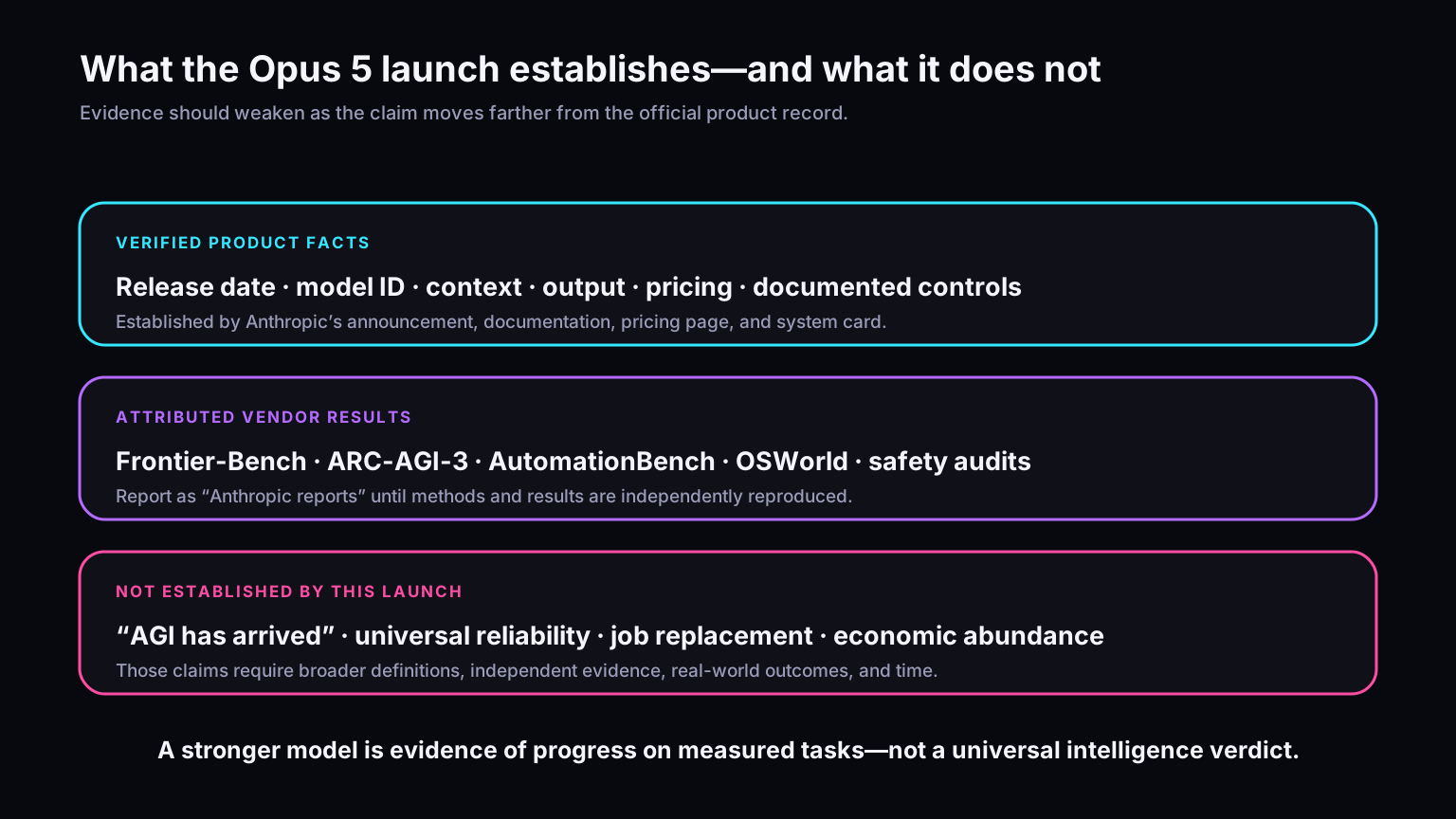
The release is a meaningful capability step. It is also important not to turn a strong model launch into a claim the evidence cannot support: Claude Opus 5 does not prove that AGI has arrived.
This guide separates three things:
- confirmed product facts from Anthropic's documentation;
- benchmark results that Anthropic reports;
- my interpretation of what the release means for builders and the AGI debate.
Claude Opus 5 at a glance#
| Feature | Confirmed detail |
|---|---|
| Release date | July 24, 2026 |
| API model ID | claude-opus-5 |
| Standard API price | $5 per million input tokens; $25 per million output tokens |
| Fast mode price | $10 per million input tokens; $50 per million output tokens |
| Context window | 1 million tokens |
| Maximum output | 128,000 tokens |
| Thinking | Enabled by default |
| Effort levels | low, medium, high, xhigh, and max |
These are product specifications, not estimates. Sources: Anthropic's launch announcement, model overview, Opus 5 feature guide, and pricing documentation.
What changed#
A model built for long, difficult work#
Anthropic positions Opus 5 around complex agentic tasks rather than short-answer novelty. That includes large codebase work, research, tool use, and workflows that require the model to preserve intent over many steps.
The one-million-token context window makes it possible to place much larger repositories, document collections, and operational histories in a single working context. The 128,000-token output limit also matters for migrations and structured deliverables that would otherwise require repeated continuation calls.
Neither number guarantees comprehension or correctness across the full window. Context capacity tells us how much material the system can accept; evaluations on representative work tell us how well it uses that material.
Thinking is the default, with a wider effort range#
Opus 5 has thinking enabled by default. Developers can select five effort levels: low, medium, high, xhigh, and max.
That is useful because “use the smartest model” is not a complete production strategy. A classification step may need low effort and low latency. A difficult architectural review may justify max effort. The right comparison is total task quality, time, and cost, rather than the model name alone.
Fast mode trades price for latency#
Anthropic says optional fast mode delivers up to 2.5 times higher output tokens per second. Read that number carefully: the documented gain is in throughput, not in time to first token, and 2.5 times is a ceiling rather than a typical result. It carries a separate price: $10 per million input tokens and $50 per million output tokens, twice the standard $5/$25 rate.
Fast mode is also not something you can simply switch on. It is a research preview, it runs on the first-party Claude API only, and access goes through an account manager or a waitlist.
Fast mode is therefore a workload decision, not a free acceleration switch. It may make sense for interactive coding, incident response, or expensive human-in-the-loop sessions where latency costs more than tokens. Background research and batch work may be better served by standard mode.
Pricing: what a real task costs#
Token prices are useful, but teams buy completed work rather than abstract tokens.
At standard rates:
- one million input tokens cost $5;
- one million output tokens cost $25;
- 100,000 input tokens plus 20,000 output tokens cost about $1;
- prompt caching, batch processing, and tool activity can change the final bill.
At fast-mode rates, that same 100,000-input and 20,000-output example costs about $2.
Before migrating a production workload, measure:
- success rate on your actual tasks;
- average input and output tokens per successful task;
- retries and human correction time;
- latency at the effort level you intend to use;
- the cost of failures, not only successful calls.
A more capable model can be cheaper per completed job even when its token price is higher. The opposite can also be true if a workflow sends unnecessary context or lets an agent wander.
Benchmarks: impressive, but read the attribution#
Anthropic reports that Claude Opus 5:
- scores more than twice as high as Opus 4.8 on Frontier-Bench;
- achieves an ARC-AGI-3 score three times higher than the next-best model tested in Anthropic's comparison;
- improves materially on long-horizon agentic work, coding, and computer-use evaluations.
Those results deserve attention, but the wording matters. They are Anthropic-reported benchmark results from the model's launch materials and System Card. They are not the same thing as independent replication, and a benchmark score is not a universal measure of intelligence.
Good evaluation hygiene asks:
- Was the exact model configuration documented?
- Is the test set public, private, or contamination-resistant?
- How much inference compute and scaffolding were used?
- Does the task resemble the work you need done?
- Can independent evaluators reproduce the ordering?
- What important failure modes does the benchmark omit?
Anthropic's reported gains are evidence. They are not the final word.
Does Claude Opus 5 mean AGI is here?#
No. The available evidence does not support that claim.
“AGI” has several competing definitions. Some emphasize human-level performance across most cognitive tasks. Others require economic substitutability, fast adaptation to unfamiliar domains, reliable autonomy, or the ability to learn and act in the physical world. There is no single benchmark whose threshold settles the question.
Opus 5's strong results show progress on specific measured capabilities. They do not by themselves establish:
- robust competence across every economically important domain;
- dependable operation in unfamiliar, adversarial, or high-stakes environments;
- autonomous learning equivalent to a human's open-ended adaptation;
- reliable physical-world agency;
- consensus among independent researchers that an AGI threshold has been crossed.
The evidence is more interesting than the hype: advanced models are becoming able to complete longer and more complex units of knowledge work, while reliability, evaluation, governance, and access remain decisive constraints.
What I got right and wrong before launch#
The original version of this page made predictions from Anthropic's release trajectory. Scoring those predictions is more useful than quietly deleting them.
| Pre-release prediction | Result | Score |
|---|---|---|
| A model using the Opus 5 name was plausible but uncertain. | Anthropic used exactly that name. | Right, but too cautious |
| The next flagship would focus on longer agentic runs and difficult coding work. | That is central to Anthropic's launch positioning. | Right |
| Adaptive thinking and explicit compute control would become more important. | Thinking is enabled by default and effort now spans five levels. | Right |
| Standard Opus pricing might remain near $5/$25. | Standard pricing is exactly $5/$25. | Right |
| The launch would push stronger computer use. | Anthropic reports gains in computer-use and agentic evaluations. | Right |
| A differently named tier might remain above Opus. | Claude Fable 5 shipped on June 9, 2026 and still sits above Opus 5, with the restricted Claude Mythos 5 ahead on cybersecurity work. | Right |
| I should avoid guessing an exact date, score, context limit, or output limit. | The eventual values could not be responsibly confirmed before launch. | Right editorial choice |
Overall: six capability, pricing, and lineup predictions were directionally right, and the decision not to invent specifications was correct.
Prediction posts can still be useful when they remain visibly labeled as forecasts and are corrected promptly when primary-source facts arrive.
How developers should evaluate Opus 5#
Use the real model ID#
The API identifier is claude-opus-5. Confirm availability and current platform-specific details in Anthropic's models overview before changing production configuration.
Test complete workflows, not trivia#
Build a small evaluation suite from work your team actually performs:
- a bug with a known root cause;
- a code review containing subtle security and maintainability issues;
- a multi-file feature with acceptance criteria;
- a research task with required citations;
- a browser or computer-use workflow with clear completion evidence;
- an adversarial case where the right answer is to stop or ask for approval.
Measure outcome quality, false confidence, intervention rate, latency, and total cost.
Keep bounded autonomy#
Longer-horizon capability increases both usefulness and the size of a possible mistake. Preserve:
- least-privilege tool access;
- checkpoints before irreversible actions;
- explicit review for security, money, private data, and production changes;
- resumable state;
- logs that show what the agent did without storing unnecessary sensitive data.
The model can take on more of the execution. Accountability still belongs to the people deploying it.
Compare effort levels#
Run the same representative tasks at medium, high, xhigh, and max before defaulting everything to the most expensive setting. Some work will plateau early. Other tasks may improve enough at high effort to reduce retries and human review.
What Opus 5 means beyond the launch#
The most consequential trend is the size of the task a frontier model can complete coherently. If models can move from drafting a function to delivering a reviewed migration, or from summarizing a document to investigating a question with verifiable sources, then the unit economics and organization of knowledge work change.
But intelligence is only one layer of the system. Productive outcomes still depend on tools, data quality, permissions, energy, hardware, institutions, ownership, and distribution. Better models can increase productive capacity without automatically making their benefits affordable or universal.
That distinction is why I am treating AGI as an evidence question rather than a launch slogan. The economic conversation cannot stop at benchmark charts.
My read on the release#
Claude Opus 5 is available now with standard API pricing of $5 per million input tokens and $25 per million output tokens, optional faster inference at $10/$50, a one-million-token context window, 128,000-token maximum output, thinking enabled by default, and five effort levels.
Anthropic reports substantial benchmark improvements, including more than double Opus 4.8 on Frontier-Bench and three times the next-best ARC-AGI-3 score in its comparison. Those are notable vendor-reported findings that should be tested independently and against real workloads.
It is also worth being precise about where the model sits. Opus 5 is the value tier beneath Claude Fable 5, not the frontier itself, and Anthropic argues it approaches Fable 5 at half the price. That is a claim about cost per completed task, and cost per completed task is exactly the thing you can measure on your own work.
The release advances agentic AI. It does not prove AGI. The practical response is to evaluate it carefully, redesign workflows around larger reliable units of work, and keep strong boundaries around consequential actions.
Sources and evidence
Product claims are attributed to their publishers. Measurements and projections retain their original scope, date, and uncertainty.
- Verified factofficial product announcementIntroducing Claude Opus 5
Anthropic · Published Jul 24, 2026 · Accessed Jul 26, 2026
Supports: release date, model availability, standard and fast-mode pricing; Anthropic-reported benchmark and safety results.
- Verified factofficial product documentationWhat's new in Claude Opus 5
Anthropic · Accessed Jul 26, 2026
Supports: thinking defaults and effort controls.
- Verified factofficial model catalogClaude models overview
Anthropic · Accessed Jul 26, 2026
Supports: API model ID, context window, maximum output, and platform availability.
- Verified factofficial pricing documentationClaude API pricing
Anthropic · Accessed Jul 26, 2026
Supports: standard and fast-mode token prices.
- Verified factofficial system cardClaude Opus 5 System Card
Anthropic · Published Jul 24, 2026 · Accessed Jul 26, 2026
Supports: documented evaluation scope, limitations, safety, and alignment findings.
Article changelog
- Jul 30, 2026: Corrected the model-lineup framing after re-verifying against Anthropic's documentation. Claude Fable 5 has been generally available since June 9, 2026 and remains Anthropic's most capable widely released model, so Opus 5 was never the top tier. Rescored the lineup prediction and tightened the fast-mode description to Anthropic's documented wording.
- Jul 26, 2026: Rewritten from the ground up after the July 24 launch, using confirmed product facts and a scorecard of the earlier predictions.
- Jul 2, 2026: Published as pre-release analysis of Anthropic's expected next flagship.
Questions
Is Claude Opus 5 released?+
Yes. Anthropic launched Claude Opus 5 on July 24, 2026. The API model ID is claude-opus-5, and the model is also available through Anthropic's Claude products and supported cloud platforms.
How much does Claude Opus 5 cost?+
Standard API pricing is $5 per million input tokens and $25 per million output tokens. Anthropic also offers an optional fast mode at $10 per million input tokens and $50 per million output tokens.
What are Claude Opus 5's context and output limits?+
Anthropic's model documentation lists a one-million-token context window and a maximum output of 128,000 tokens.
Does Claude Opus 5 prove that AGI has arrived?+
No. Strong performance on difficult evaluations is evidence of progress on those measured tasks, not proof of a generally accepted AGI threshold. AGI has no single authoritative benchmark, and vendor-reported results need independent evaluation and real-world validation.
How should developers migrate to Claude Opus 5?+
Use the claude-opus-5 model ID, test the model on a representative set of real tasks, review the new thinking and effort controls, and keep checkpointing, permission boundaries, and human review for consequential agentic work.