The Impact of AI Art on the World: A Catalyst for Creativity
AI art can flatten culture or pressure artists toward more intentional work. This revised essay keeps the original optimism while confronting consent, authorship, provenance, labor, and the fact that no style is permanently safe from imitation.
By Muhamad J. Akoum Senior Product Engineer
- AI art
- creativity
- generative AI
- Ancient Prayers
- music
- authorship
- provenance
Evidence reviewed: Jul 26, 2026
Next review: Jan 22, 2027
Freshness: active · 180-day cadence
Primary question: how will AI art affect human creativity
Editorial role: perspective
Editorial status: Personal perspective, revised with sourced constraints. I am an artist and engineer, not a court. Copyright rules vary by jurisdiction, and the ethical disputes around training data remain active.
In 2023, I published an argument that made some artists uncomfortable:
AI-generated art could become a catalyst for human creativity.
The fear at the time was understandable. If a machine can produce an image, song, or paragraph in seconds, what happens to people who spent decades learning to make those things?
My answer was optimistic. AI learns from existing patterns, so artists could respond by refusing the familiar and venturing into the unknown.
Three years later, I still believe the core idea.
I no longer believe the simple version.
What I got right in 2023#
Generative systems are exceptionally good at producing recognizable patterns.
Ask for the surface signals of a genre and the system can assemble them quickly: the color palette, lens, harmony, rhythm, prose cadence, arrangement, or visual grammar that tells an audience what box the work belongs in.
This makes imitation cheaper.
It also exposes how much commercial culture was already built from repeated patterns. If a genre can be reduced to a compact prompt and a statistical average, the model did not single-handedly make the genre formulaic. It found the formula we had already rewarded.
That can be artistically useful information.
AI becomes a mirror held up to cultural repetition. The reflection is not always flattering.
What I got wrong#
In the original essay, I suggested that new or experimental styles would remain unique and untouched by AI.
That was too absolute.
No style comes with permanent machine immunity. Once enough traces exist in works, descriptions, neighboring styles, recordings, references, or derivative examples, a system may approximate the surface.
The durable human advantage is not:
My style can never be copied.
It is:
I can change what I am trying to do.
A model can chase yesterday's artifacts. An artist can abandon yesterday's intention.
That is not mystical. It is the practical ability to revise the objective because life changed, a relationship ended, a city collapsed, a child was born, a sound became unbearable, or a previously beautiful rule began to feel dishonest.
More output does not mean more culture#
Generative AI expands the supply of competent-looking material.
That can lower barriers for people who could not draw, animate, orchestrate, or afford production. It can help someone externalize an idea for the first time. That matters.
But infinite output creates another problem: attention does not expand at the same rate.
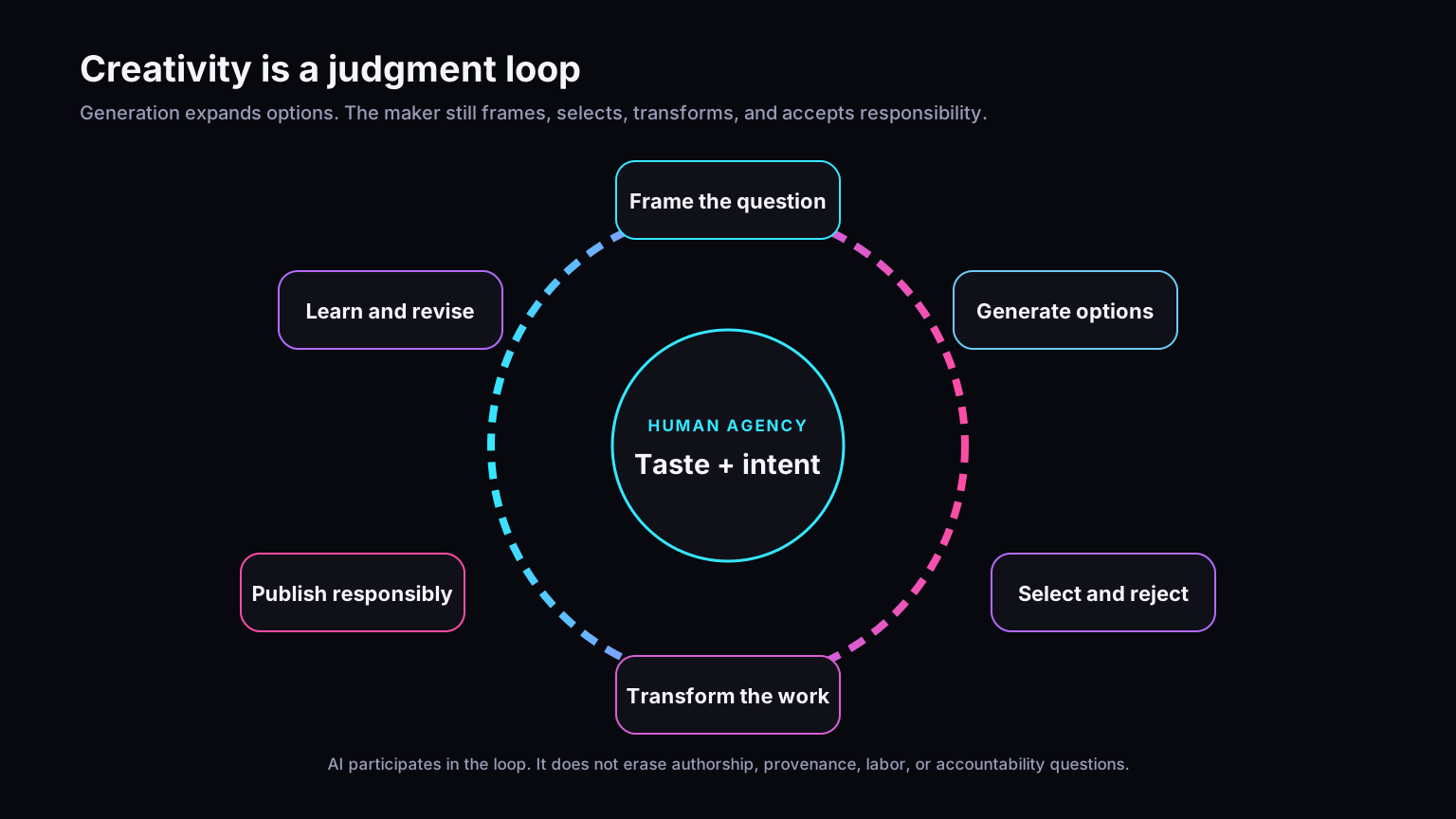
When a million images become available before lunch, making an image is no longer the full creative act. Choosing what deserves to exist, developing it, placing it in context, and accepting responsibility for it become more important.
The scarce thing moves from production toward judgment.
This is the same argument I make in Taste Is the New 10x: when generation becomes cheap, selection and commitment become visible.
AI can be both catalyst and solvent#
The optimistic path is real:
- A musician explores timbres outside their physical instrument collection.
- A filmmaker prototypes scenes before raising money.
- A disabled creator uses a new interface to express an image that motor constraints made difficult.
- A writer tests structures and hears where the argument is hollow.
- A child sees an idea rendered and becomes curious enough to learn the craft.
The darker path is real too:
- Platforms flood markets with low-cost imitations.
- A living artist's recognizable identity becomes a selectable preset.
- Training and licensing arrangements remain opaque.
- Employers use generation to reduce budgets without redistributing productivity gains.
- Audiences cannot tell who made or authorized what.
- Creators stop developing because the first plausible output feels finished.
Calling AI a catalyst does not erase the solvent.
Consent is not a creativity problem#
Artists are sometimes told that objections to training data mean they fear technology.
That is intellectually lazy.
A person can believe generative tools expand creative possibility and still demand consent, compensation, attribution, privacy, and meaningful ways to opt out. These are governance questions, not symptoms of insufficient imagination.
The UNESCO Recommendation on the Ethics of AI places human rights, cultural diversity, transparency, and oversight at the center of AI governance. The World Intellectual Property Organization treats the intersection of AI and intellectual property as an active policy field rather than a settled slogan.
The honest creative position can hold two ideas at once:
- Generative systems can unlock new forms of expression.
- The way systems obtain and commercialize creative material still matters.
Authorship is a chain of decisions#
In the United States, the Copyright Office's 2025 report maintains that copyright protects human-authored expression, not purely AI-generated material. It also explains why prompts alone usually do not give a person sufficient control over the expressive details of an output.
That does not mean AI-assisted work contains no human authorship.
It means the human contribution must be found in actual human decisions: selection, arrangement, performance, editing, transformation, timing, compositing, and the authored elements around the generated material. The answer is fact-specific.
For an artist, this creates a useful practical question:
Where, exactly, did I decide?
If the answer is "I typed one sentence and accepted the first result," the machine did not catalyze much craft.
If the answer involves a long trail of intention, rejection, performance, restructuring, synthesis, and final responsibility, the tool occupies a different place.
Provenance becomes part of the artwork's integrity#
When synthetic and human-made media can look identical, audiences need more than intuition.
The C2PA standard provides a technical way to attach signed provenance assertions to media. No standard can prove the philosophical value of an artwork, and metadata can be absent. Still, provenance infrastructure helps creators and publishers document origin and edits.
My practical rules are simple:
- keep source files and project history;
- document generated components;
- preserve licenses and model terms used at the time;
- do not imply a human performance that never occurred;
- credit collaborators, including dataset or source creators when required and possible;
- retain enough evidence to explain the work later.
Transparency does not make weak art strong. It makes the relationship with the audience less dishonest.
The music case#
I make experimental ambient music as Ancient Prayers.
My 2023 instinct was that an AI trained on everything I had released still could not predict what I would make next because I did not want the next piece to resemble the previous one.
Today I would phrase it more carefully:
The system may imitate surfaces from my past. My responsibility is to keep changing the question.
In my own workflow, AI can help generate disposable seeds or reduce blank-page friction. It does not own arrangement, dynamics, silence, performance decisions, mixing, mastering, or the final yes.
The detailed boundary is in AI Won't Write Your Record.
The point is not purity. It is authorship.
The danger of optimizing for uncopyable#
Artists can react to AI badly by trying to become deliberately illegible.
If a work exists only to evade machine imitation, the machine still controls the agenda.
Originality is not random noise. It is not being strange on command. It is the consequence of following a real artistic necessity farther than convention would prefer.
The goal is not:
Make something the model cannot copy.
It is:
Make the thing you could not honestly replace with a familiar answer.
Sometimes that work will be simple. Sometimes beautiful. Sometimes ugly. Sometimes an AI tool will be inside the process. The criterion is not technological purity; it is whether the work has a human reason to exist.
The catalyst thesis, rebuilt#
AI art can catalyze creativity when it:
- lowers the cost of exploration without pretending exploration is completion;
- reveals formulas artists have mistaken for identity;
- gives more people access to expressive tools;
- makes taste, context, and commitment more important;
- encourages artists to change direction instead of defending a frozen style.
It suppresses creativity when it:
- substitutes volume for intention;
- appropriates identity without consent or recourse;
- hides provenance;
- concentrates economic value while externalizing creative labor;
- makes the first plausible output feel sufficient.
The technology contains both possibilities.
Our workflows, platforms, markets, laws, and artistic courage decide which one grows.
My answer is still yes, with conditions#
I am not afraid that a machine can generate an image or song.
I am concerned about who owns the system, what it learned from, who is paid, how audiences know what happened, and whether artists trade the difficult development of judgment for an infinite button.
AI can be a catalyst for creativity.
But a catalyst does not choose the reaction.
We do.
Sources and evidence
Product claims are attributed to their publishers. Measurements and projections retain their original scope, date, and uncertainty.
- Verified factofficial legal policy reportCopyright and Artificial Intelligence, Part 2: Copyrightability
U.S. Copyright Office · Published Jan 29, 2025 · Accessed Jul 26, 2026
Supports: U.S. copyright protects human-authored expression rather than purely AI-generated material; prompts alone generally do not provide sufficient human control over expressive elements.
- Verified factofficial policy hubCopyright and Artificial Intelligence
U.S. Copyright Office · Accessed Jul 26, 2026
Supports: current U.S. policy materials cover digital replicas, copyrightability, and generative-AI training.
- Attributed definitioninternational normative frameworkRecommendation on the Ethics of Artificial Intelligence
UNESCO · Published Nov 23, 2021 · Accessed Jul 26, 2026
Supports: AI governance should protect human rights, cultural diversity, transparency, and human oversight.
- Verified factopen provenance standardC2PA Technical Specification
Coalition for Content Provenance and Authenticity · Accessed Jul 26, 2026
Supports: content provenance can be represented through signed assertions and manifests.
- Verified factintergovernmental policy resourceArtificial Intelligence and Intellectual Property
World Intellectual Property Organization · Accessed Jul 26, 2026
Supports: generative AI raises unresolved questions across copyright, data, attribution, and ownership.
Article changelog
- Jul 26, 2026: Removed the absolute claim that new styles remain untouched by AI, added authorship and provenance evidence, addressed consent and labor, and preserved the original catalyst-for-creativity thesis as personal opinion.
- Apr 21, 2023: Original essay published on Medium.
Questions
Is AI-generated art protected by copyright?+
In the United States, purely AI-generated expressive material is not protected by copyright. Human-authored selection, arrangement, editing, performance, or transformation may be protected depending on the facts. Other jurisdictions may differ. This is general information, not legal advice.
Will original artistic styles remain impossible for AI to imitate?+
No style is guaranteed permanent immunity. A model may approximate a recognizable surface once enough examples, descriptions, or related patterns exist. The more defensible human advantage is the capacity to change intention, context, process, and direction, rather than rely on a magical style shield.
Does using AI make someone an artist?+
A tool does not settle the question. The artist's contribution may include intention, curation, performance, transformation, context, and accountability. Publishing an unexamined first output shows less human authorship than building a deliberate work through many human decisions.
Is the author against AI music?+
No. As Ancient Prayers, the author uses AI selectively for exploration while keeping composition decisions, arrangement, editing, mixing, mastering, provenance, and final responsibility human-led.