What Remains Scarce After AGI?
A post-AGI world could make cognitive labor radically cheaper while leaving physical, ecological, institutional, and human bottlenecks intact. This essay separates intelligence abundance from delivered human access.
By Muhamad J. Akoum Senior Product Engineer
- AGI
- scarcity
- Universal Basic Abundance
- energy
- housing
- critical minerals
- AI governance
Part of the Universal Basic Abundance evidence cluster.
Evidence reviewed: Jul 26, 2026
Next review: Oct 24, 2026
Freshness: active · 90-day cadence
Primary question: what remains scarce after AGI
Editorial role: analysis
Editorial status: Scenario analysis. No current system is treated here as universally recognized AGI. The essay asks what would remain constrained even if generally capable AI made cognitive labor dramatically cheaper.
When people imagine AGI, they often imagine the end of scarcity.
The reasoning is seductive:
- Intelligence solves problems.
- AGI supplies enormous intelligence.
- Therefore every problem becomes cheap.
The first step is incomplete. The second is hypothetical. The conclusion does not follow.
Intelligence can design a power plant. It cannot make a transmission line appear before permits, materials, finance, construction, and public consent exist.
It can optimize a city. It cannot create another center of Beirut, London, or Tokyo with the same history, relationships, and coordinates.
It can generate ten million songs. It cannot give a listener ten million evenings.
AGI would change scarcity. It would not repeal it.
Start with the right claim#
There is no single accepted AGI threshold. Google DeepMind's levels framework treats performance, generality, and autonomy as dimensions rather than one magic switch.
For this essay, post-AGI means a scenario in which systems can perform most cognitive tasks that societies currently pay people to perform, across many domains, with substantial autonomy.
Even under that strong assumption, at least four classes of scarcity remain:
- Physical: energy, land, materials, water, infrastructure, and logistics.
- Ecological: emissions, biodiversity, waste absorption, and planetary resilience.
- Institutional: trust, legitimacy, coordination, rights, and competent delivery.
- Human: attention, time, care, presence, meaning, and lived experience.
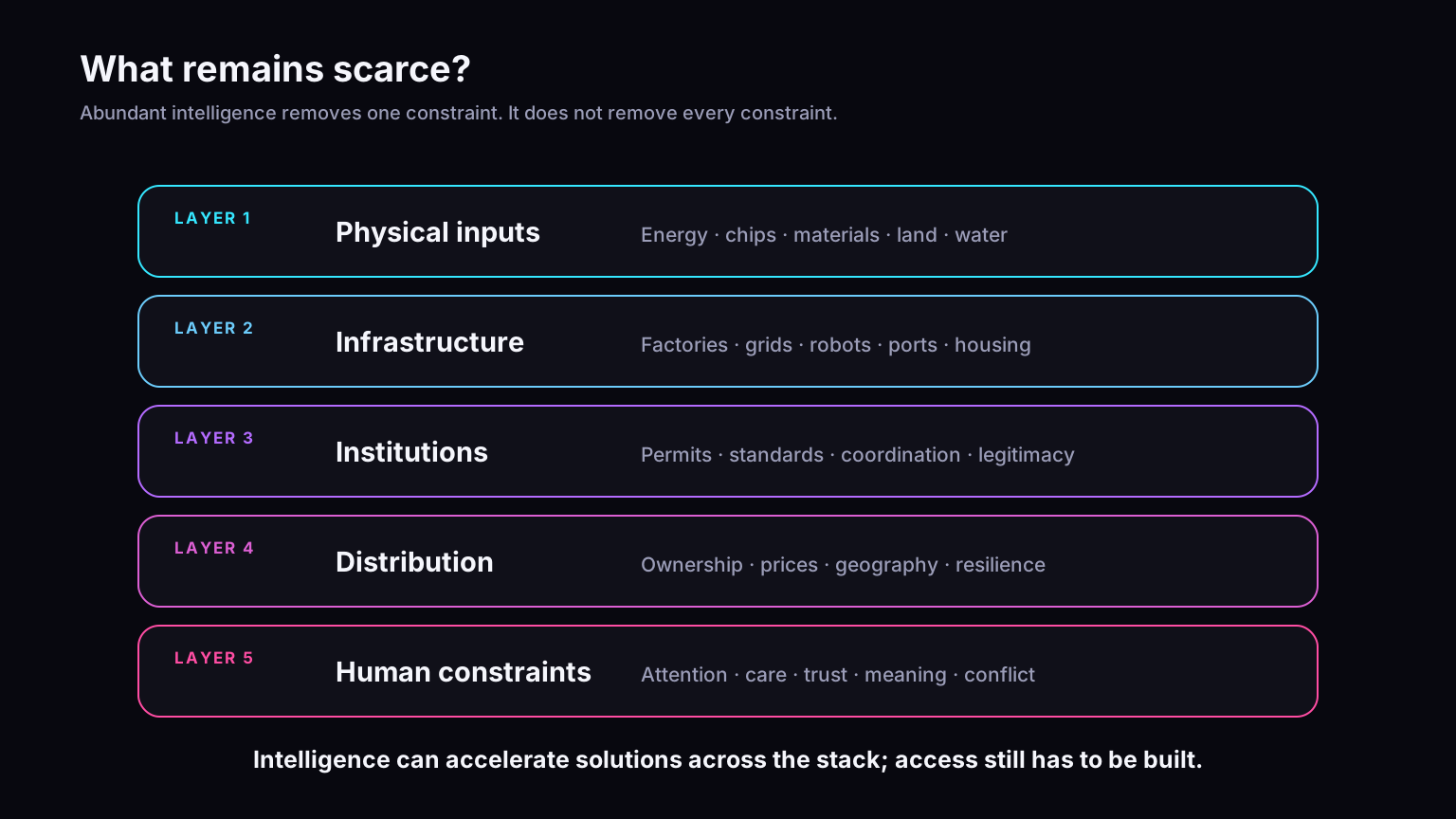
The bottleneck moves from "can anyone think of a solution?" toward "can the world build, govern, distribute, and live with it?"
Energy remains physical#
Every model call is an event in a physical system.
It uses data centers, chips, cooling, networks, grid capacity, and generation. Better algorithms and hardware can reduce energy per unit of useful work, but demand can grow faster than efficiency.
The International Energy Agency's 2026 central projection places global data-center electricity demand at roughly 950 TWh in 2030, up from around 485 TWh in 2025. That is a projection with uncertainty, not a guaranteed trajectory. It still makes the category error obvious:
Cheap intelligence does not mean free electricity.
AGI could improve grid planning, materials discovery, generation design, and operational efficiency. Those advances still need steel, copper, transformers, rights of way, technicians, financing, construction time, and political agreement.
Materials remain concentrated#
Software can be copied. Minerals cannot.
Chips, batteries, grids, motors, robots, and renewable systems depend on physical supply chains. The IEA's Critical Minerals Outlook tracks substantial geographic concentration in the mining and especially refining of several important minerals.
AGI might discover substitutions or improve recycling. Until those processes operate at scale, supply remains constrained.
A post-AGI society that ignores materials could create a strange hierarchy:
- intelligence abundant;
- machines expensive;
- infrastructure delayed;
- benefits concentrated where atoms are already organized.
Land and location remain unique#
AGI can design more efficient housing. It cannot make all land equivalent.
A safe home near family, work, healthcare, water, culture, and transport is not interchangeable with an empty structure far away. Location includes social networks and history, not only square meters.
Construction may become more automated. Planning, land ownership, public infrastructure, and local legitimacy still shape what gets built.
Housing abundance cannot be measured only by the number of generated blueprints or even national unit counts. It must measure whether people can access appropriate homes where life is actually possible.
Food reveals the delivery problem#
Humanity can produce enormous quantities of food while people remain hungry.
The FAO's 2025 food-security report focuses on hunger, affordability, and access. Its existence is a reminder that aggregate production is not the same as a reliable meal reaching a household.
Food depends on:
- soil, water, energy, and climate;
- storage and cold chains;
- transport and markets;
- household income;
- conflict and political stability;
- culturally appropriate diets;
- care work required to prepare and share it.
AGI can improve forecasting and logistics. A broken road, war, monopoly, or empty wallet can still stop the outcome.
Access remains a separate engineering layer#
The frontier often confuses existence with access.
A model exists. A paper exists. A treatment exists. A fiber line passes nearby.
Therefore, the story says, people have the capability.
But real access passes through multiple gates:
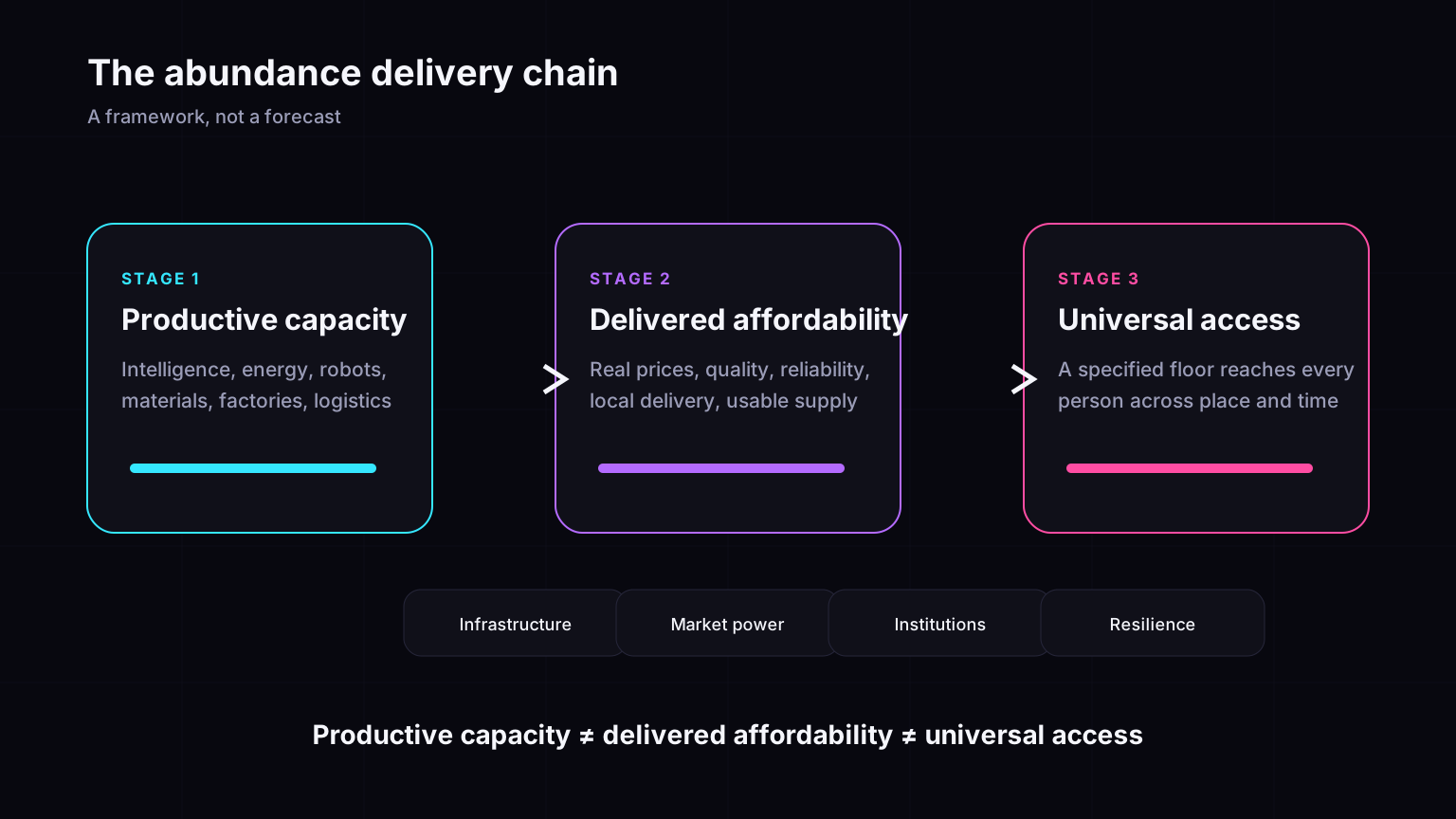
- Technical capability: Does the thing work under defined conditions?
- Production capacity: Can enough of it be produced?
- Infrastructure: Can it reach the person?
- Affordability: Can the household or public system pay?
- Eligibility and usability: Is the person permitted and able to use it?
- Quality and reliability: Does it work consistently enough to matter?
- Recourse: What happens when it fails?
The International Telecommunication Union continues to document unequal connectivity even though internet technology is mature. The remaining gap is not a lack of knowledge about what the internet is.
Trust cannot be generated on demand#
An AGI system may produce a correct recommendation. People can still rationally refuse it.
Trust depends on history, incentives, accountability, competence, and whether the institution repaired past harms. A fluent explanation is not the same as a trustworthy relationship.
The OECD's work on institutional trust examines responsiveness, reliability, integrity, fairness, and openness. These qualities require behavior over time.
AI can support them. It can also manufacture persuasive language around their absence.
In an abundant information environment, trustworthy institutions may become even more valuable.
Legitimacy remains political#
Suppose an AGI can calculate the most efficient allocation of water, housing, medicine, or electricity.
Who authorized the objective?
Which harms count?
Who can appeal?
What rights are not available for optimization?
Efficiency cannot answer these questions because the definition of efficiency already contains political choices. A technically excellent allocation can still be illegitimate if people had no voice, the rules are discriminatory, or no one is accountable.
Legitimacy is not an output token.
Human attention becomes more scarce#
Generative systems can produce almost unlimited text, images, music, video, simulations, and personalized persuasion.
Human attention remains finite.
This creates an inversion:
- content approaches abundance;
- being genuinely noticed becomes expensive;
- discovery becomes difficult;
- selection systems gain power;
- trusted curators become important;
- silence becomes a luxury.
The AI-art essay explores this from the creator's side. Infinite production does not create infinite culture because an audience still has one life.
Care and presence remain embodied#
An advanced system may diagnose, schedule, translate, monitor, and coach better than current tools.
That does not make human presence irrelevant.
Care includes physical work, shared risk, touch, trust, advocacy, and the knowledge that another person chose to stay. Some parts may be automated. Some people may prefer machines in vulnerable contexts. Other parts derive value precisely from mutual human commitment.
Treating every preference for human care as inefficiency would misunderstand what the service is.
Meaning remains non-transferable#
An AGI could propose a purpose for your life.
It cannot make the purpose yours.
Meaning is not merely the best sentence describing an objective. It is entangled with commitment, sacrifice, memory, identity, and relationships. A system can help someone reflect. It cannot outsource the act of caring.
This does not make meaning supernatural. It makes it participatory.
Ownership may become the decisive scarcity#
If intelligence is abundant but a few firms control models, chips, robots, energy contracts, and distribution, society may face abundance in production and scarcity in permission.
The output exists. Access requires rent.
The machine can do the work. Someone else owns the machine.
Ownership deserves its own analysis. The central economic question is not only what AI can produce, but who can direct the productive system and who captures the result.
What abundance should actually measure#
A serious Abundance Index would track each essential domain across at least seven dimensions:
| Dimension | The question |
|---|---|
| Capacity | Can society produce enough? |
| Delivered price | What does access cost at the point of use? |
| Coverage | Who can actually obtain it? |
| Quality | Is the capability sufficient for a dignified life? |
| Reliability | Does it survive failures and shocks? |
| Environmental load | What resources and harms does delivery require? |
| Concentration | How dependent is access on a small set of owners or places? |
The domains should include energy, food, housing, healthcare, education, connectivity, compute and AI access, mobility, and time autonomy.
A model benchmark belongs in the capacity story. It is not the whole story.
AGI changes the shape of scarcity#
If cognitive labor becomes radically cheaper, many things could improve:
- faster science;
- better design;
- personalized learning;
- lower administrative cost;
- improved planning;
- more accessible expertise;
- faster iteration on public systems.
That is enormous.
But it also increases the value of everything intelligence cannot instantly duplicate: energy, atoms, trusted relationships, legitimate institutions, scarce locations, human attention, ecological stability, and the authority to decide.
The right conclusion is neither "AGI solves everything" nor "nothing changes."
It is:
Intelligence abundance creates a new bottleneck map.
Universal Basic Abundance must be built around that map, not around the fantasy that software has abolished the world.
Sources and evidence
Product claims are attributed to their publishers. Measurements and projections retain their original scope, date, and uncertainty.
- Estimate / projectionintergovernmental energy analysisKey Questions on Energy and AI
International Energy Agency · Published Apr 16, 2026 · Accessed Jul 26, 2026
Supports: data-center electricity demand could grow substantially through 2030; grid connections and power-system buildout are material AI constraints.
- Measured findingintergovernmental materials analysisGlobal Critical Minerals Outlook 2025
International Energy Agency · Published May 21, 2025 · Accessed Jul 26, 2026
Supports: supply chains for several energy and technology minerals are geographically concentrated.
- Measured findinginternational food-security reportThe State of Food Security and Nutrition in the World 2025
Food and Agriculture Organization of the United Nations · Published Jul 28, 2025 · Accessed Jul 26, 2026
Supports: adequate production does not by itself ensure affordability and food access.
- Measured findingofficial connectivity statisticsFacts and Figures 2025
International Telecommunication Union · Published Nov 17, 2025 · Accessed Jul 26, 2026
Supports: digital access remains uneven across income groups and geographies.
- Measured findinginternational public-trust surveyOECD Survey on Drivers of Trust in Public Institutions: 2024 Results
OECD · Published Jul 10, 2024 · Accessed Jul 26, 2026
Supports: institutional trust depends on responsiveness, reliability, integrity, fairness, and openness.
- Attributed definitionresearch frameworkLevels of AGI for Operationalizing Progress on the Path to AGI
Google DeepMind · Published Jul 8, 2024 · Accessed Jul 26, 2026
Supports: AGI is not one universally agreed binary threshold.
Article changelog
- Jul 26, 2026: First publication.
Questions
Would AGI make everything free?+
No. It might reduce the cost of some cognitive labor and improve how systems are designed, but energy, land, materials, infrastructure, ecological capacity, human attention, and governance remain constrained. Lower production cost also does not guarantee a lower delivered price.
What is the most important post-AGI scarcity?+
There may be no single answer. Ownership and institutional capacity could become the binding constraints because they determine whether technical capacity becomes broadly accessible. In a local crisis, however, energy, water, housing, or logistics may dominate.
Is this essay saying AGI exists?+
No. It uses post-AGI as a scenario and does not claim that any current model meets a universal AGI threshold.
How should abundance be measured?+
Measure at least productive capacity, delivered price, access and coverage, quality and reliability, environmental load, resilience, and ownership concentration. A falling model benchmark cost is not enough.