Communism Needed Abundance. AGI Might Finally Build It.
AGI would not automatically create justice or end scarcity. This is a proposal for Universal Basic Abundance: guarantee an essential capability floor while preserving pluralism, markets, and decentralized experimentation.
By Muhamad J. Akoum Senior Product Engineer
- Universal Basic Abundance
- AGI
- artificial superintelligence
- post-scarcity
- future of work
- economics
- AI governance
Part of the Universal Basic Abundance evidence cluster.
Evidence reviewed: Jul 26, 2026
Next review: Aug 25, 2026
Freshness: fast-moving · 30-day cadence
Primary question: could AGI make universal abundance possible
Editorial role: opinion
Editorial status: Opinion / proposal. Universal Basic Abundance is my proposed framework. AGI has not been established by scientific consensus, and the post-AGI conditions below are scenarios, not predictions with a guaranteed date.
Most economic systems were built around one uncomfortable assumption:
Useful things require human labor.
Food requires farmers. Homes require builders. Medicine requires doctors. Software requires engineers. Schools require teachers. Research requires scientists. Dreams require teams, capital, and luck.
For thousands of years, this was obvious, so we built societies around labor. We made money the gatekeeper of survival. We made jobs the price of dignity. We made competition the engine of progress. We made taxes and transfers the repair mechanism for the inequality that followed.
Then AGI enters the picture.
Not today's AI assistants. Not a better chatbot. Not a benchmark graph that rises for one afternoon.
I mean a mature scenario where generally capable AI systems, autonomous agents, robotics, energy, and industrial capacity can perform most economically valuable work more effectively than humans. OpenAI defines AGI as highly autonomous systems that outperform humans at most economically valuable work. Google DeepMind proposes treating progress as levels across performance, generality, and autonomy. These are influential institutional definitions, not a single scientific verdict.
At that point the old debate changes.
The question is no longer:
How do we motivate humans to produce enough for society?
It becomes:
If machines can produce most of what society needs, why should access to life still depend on selling human labor?
That is the trapdoor under modern economics.
The one-minute version#
Communism tried to reach equality before abundance existed. Capitalism produced a powerful engine of parallel experimentation, but also tied basic dignity to success in markets and let ownership capture much of the upside.
In a post-AGI scenario, we should keep the discovery engine and remove the survival threat.
I call that Universal Basic Abundance:
A society that guarantees every person access to a democratically specified, measurable floor of essential material and digital capabilities, while preserving pluralism and decentralized experimentation above that floor.
It is not old communism. It is not capitalism with kinder taxes. It is not a promise that every resource becomes infinite.
It is a shared floor with an open sky.
First, what I mean by post-AGI#
Current AI is already changing tasks, but evidence about today's labor market does not justify saying that nearly all work has disappeared. The International Labour Organization's 2025 analysis measures occupational exposure and concludes that transformation is presently more likely than full replacement for most occupations. Exposure is not displacement.
So this essay has two clocks:
- Present evidence: AI affects workflows unevenly, organizations still need people, and labor outcomes remain uncertain.
- Post-AGI scenario: systems become able to perform most economically valuable work across domains, with robotics and infrastructure capable of turning intelligence into physical output.
The second is not a fact smuggled in from the first. It is the condition under which this proposal becomes urgent.
Communism was an abundance dream trapped in a scarcity world#
Communism is often debated badly. People defend it as a beautiful ideal or attack it only through its disasters.
The deeper point is that its higher promise required productive abundance. In the Critique of the Gotha Programme, Marx imagined a later phase only after productive forces and cooperative wealth had grown. The famous principle about needs was downstream of capacity.
The twentieth century tried to force versions of that destination into worlds where food, housing, information, industrial capacity, and administrative competence remained scarce.
The dream needed abundance. The world had rationing.
That gap did not mechanically cause every historical outcome, and this essay is not a complete history of communism. But the gap matters: equality of access is much harder when the thing being allocated is genuinely insufficient.
What capitalism got right#
Capitalism solved experimentation unusually well.
Not morally. Mechanically.
Millions of actors can try different things in parallel:
- One company tests a battery.
- Another improves logistics.
- An independent developer builds a tool no committee requested.
- A laboratory follows a strange result.
- A bad idea fails locally instead of becoming one national plan.
Markets are noisy and often unfair, but they are powerful discovery systems. They do not require one central mind to know every preference, method, and possibility in advance.
Any post-AGI system that destroys this pluralism repeats an old mistake. One giant planning model on a digital throne would still be central planning, only faster.
The future I want is shared abundance and decentralized experimentation.
What capitalism did not solve#
Capitalism is a discovery engine. It is not a dignity engine.
When ownership is concentrated, productivity gains flow first toward owners. Software scales, owners win. Automation reduces labor demand, owners win again. Workers can also benefit through higher wages, cheaper goods, or new opportunities, but those benefits are indirect, uneven, and politically contingent.
The World Inequality Report 2026 documents how concentrated wealth already is before any hypothetical post-AGI transition. The IMF warns that AI can complement some workers while displacing tasks and increasing capital returns, potentially worsening inequality.
That does not prove one inevitable future. It reveals the default direction when technology changes but ownership does not.
The post-AGI incentive problem moves#
The old question was:
How do we motivate humans to do necessary work?
If systems and machines can do nearly all necessary labor, the incentive question moves away from human hunger.
Machines do not need rent money, promotions, social status, or applause. They need energy, materials, infrastructure, objectives, feedback, constraints, maintenance, and governance.
The central questions become:
- Who owns the models, robots, energy, chips, land, and logistics?
- Which goals do they optimize?
- Who can inspect or challenge their decisions?
- Who receives the productivity dividend?
- Which essential capabilities are guaranteed regardless of market power?
This is why ownership is the core question, not a secondary footnote.
People do difficult things without the threat of poverty#
When people hear "life after compulsory work," they often imagine a civilization-sized nap.
Some people will rest. Good. A society that panics when exhausted people rest has confused burnout with virtue.
But human motivation is larger than wages. People make music, care for relatives, write open-source software, train for sports, study obscure histories, garden, volunteer, play impossible games, and solve problems nobody has priced. They do these things for autonomy, mastery, belonging, love, status, beauty, play, and purpose.
That does not mean every person instantly flourishes when a paycheck disappears. Work also supplies structure, identity, and community. A transition that removes jobs without building alternative institutions could create loneliness and disorientation.
The argument is narrower and stronger: survival anxiety is not the only possible fuel for ambition. In the companion essay on life after work, I explore why wealth already gives a minority some freedom to choose their projects. Choice, not idleness, is the point.
But atoms still charge rent#
Post-AGI does not make physical reality disappear.
Digital cognitive labor may become extremely cheap. Design, coding, tutoring, translation, planning, and administration may become cheaper. But energy, grid connections, chips, land, water, minerals, housing locations, ecological stability, and reliable institutions remain constrained.
The International Energy Agency estimates that global data-center electricity consumption could rise from about 485 TWh in 2025 to roughly 950 TWh in 2030 in its central projection. That is a forecast, not destiny, but it makes the physical point unavoidable: intelligence runs somewhere.
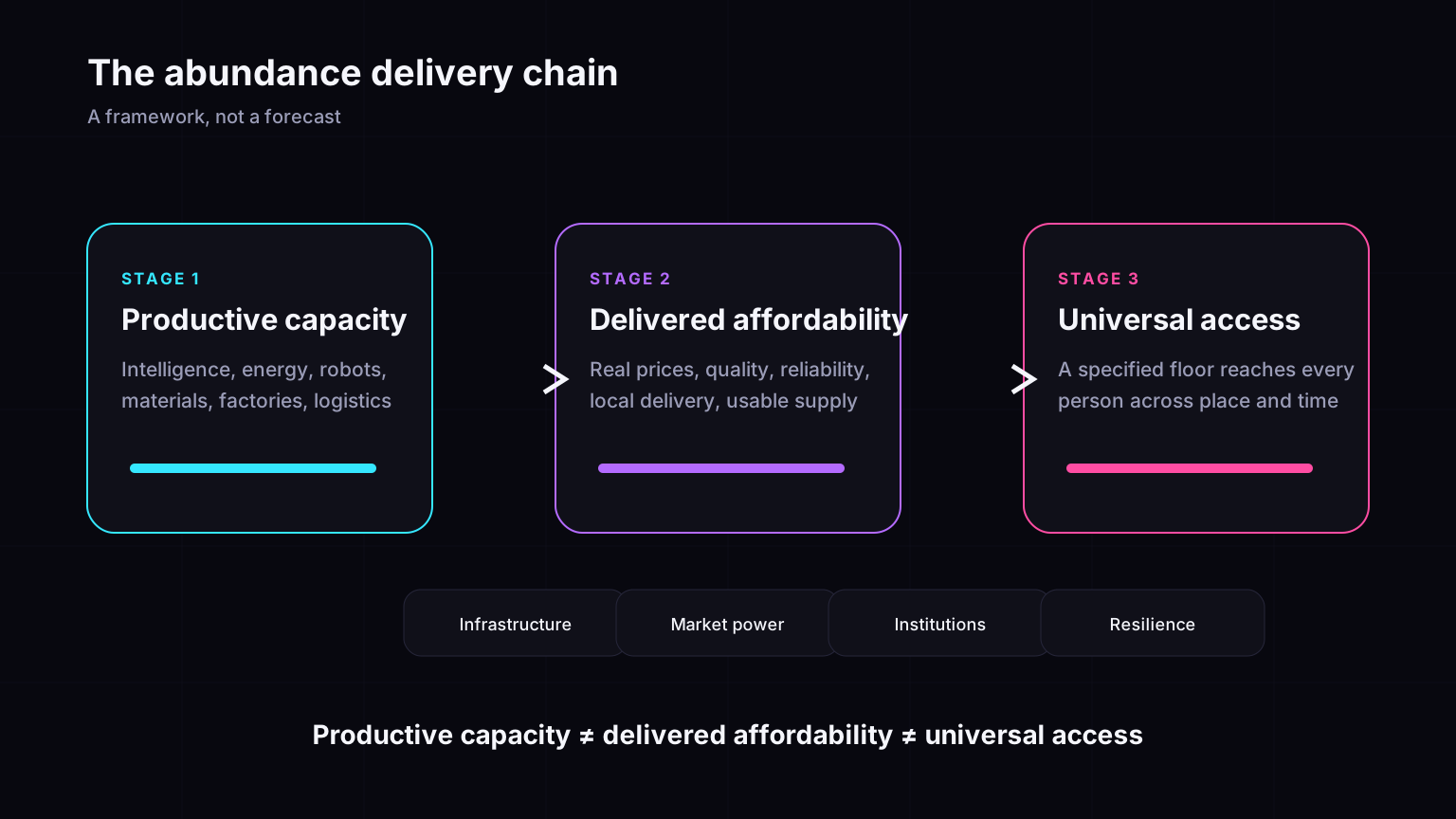
The honest abundance equation is:
- Productive capacity: Can society produce enough?
- Delivered affordability: Can it deliver the capability at a sustainable cost?
- Universal access: Can every person actually obtain it at sufficient quality?
Capacity is not affordability. Affordability is not access. None of them automatically creates legitimacy, resilience, or fair governance.
The case for Universal Basic Abundance does not require infinite abundance. It requires enough reliable capacity that basic dignity no longer needs to be rationed by income.
Three futures from the same machinery#
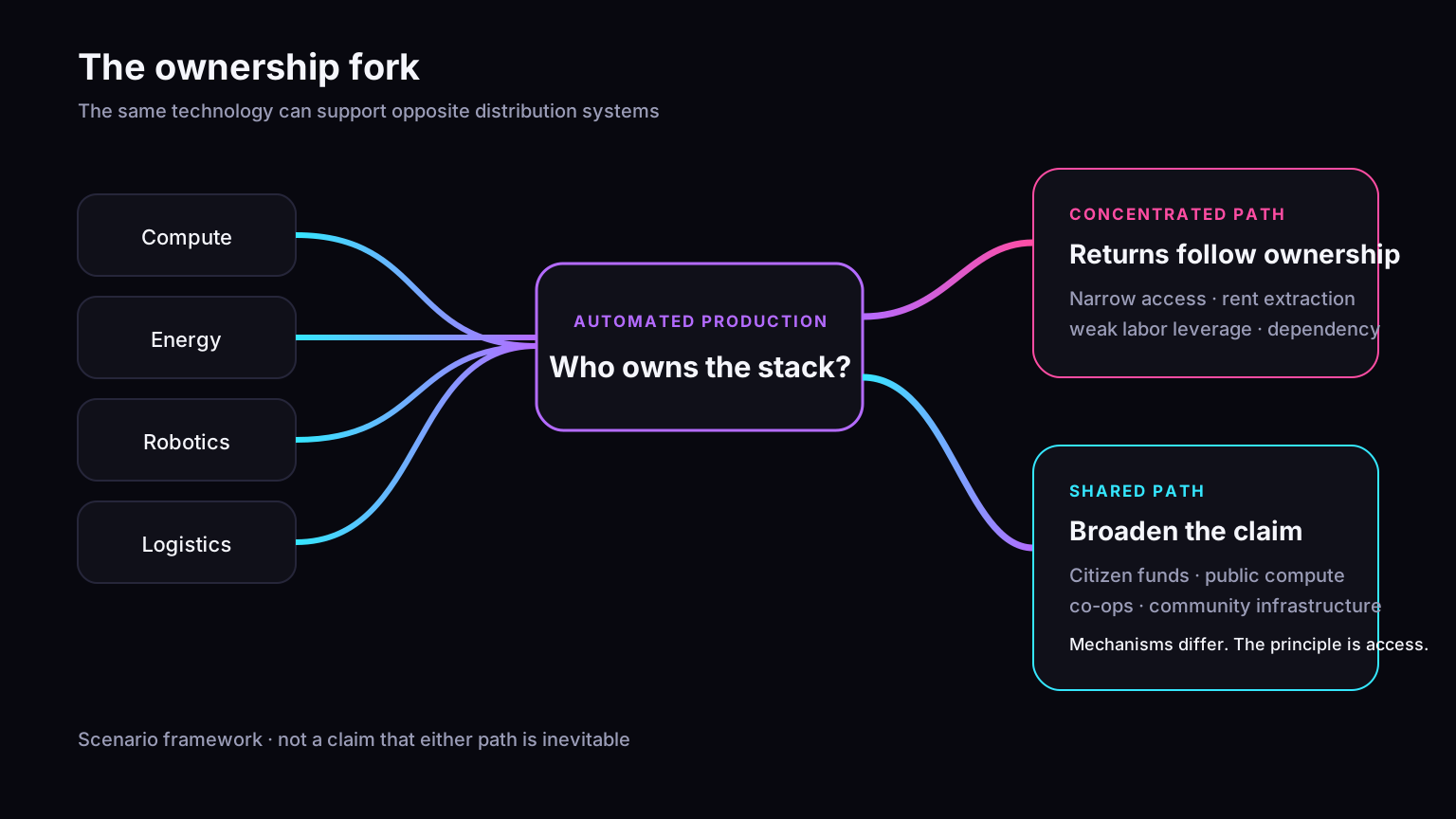
Technology does not choose its political economy. Institutions do.
Future one: hyper-capitalism#
A small group owns the models, robots, chips, data centers, energy contracts, logistics, and platforms. Labor costs fall. Productivity and profits rise. Human bargaining power weakens.
Citizens rent intelligence from corporations the way earlier societies rented access to land. AGI does not free humanity; it creates a more efficient ownership hierarchy.
Future two: total AI state control#
The state owns or directs the dominant systems. In theory this can distribute output. In practice it can combine allocation power with surveillance and suppress local experimentation.
A faster cage is still a cage.
Future three: Universal Basic Abundance#
Society builds a guaranteed capability floor while preserving many forms of ownership and experimentation above it.
Markets continue for optional goods, variety, craft, status, luxury, and discovery. Public institutions, cooperatives, companies, communities, and independent creators continue trying different paths. Nobody has to beat machines at economically valuable labor to deserve food, shelter, healthcare, learning, connectivity, energy, and legal existence.
That is the design target.
What Universal Basic Abundance includes#
The word basic must be measurable. It cannot mean "whatever remains after politics is finished."
A serious floor could include:
- nutritious food and clean water;
- safe basic housing and energy;
- preventive and essential healthcare;
- education, tutoring, and public knowledge;
- connectivity and public-interest AI access;
- basic mobility;
- legal and administrative help;
- childcare and eldercare support;
- scientific and creative tools.
Each domain needs explicit measures for capacity, delivered price, access, quality, reliability, ecological cost, and concentration risk. A glossy robot video is not an abundance metric.
This is also where terminology matters:
- Universal Basic Income is periodic, individual, universal, unconditional cash.
- Universal Basic Services focuses on collectively provided services free at the point of need.
- Universal Basic Assets is an earlier framework for access to private, public, and open assets.
- Universal Basic Abundance, as I use it, is the guaranteed capability outcome those and other instruments may help produce.
The acronym collision is real. I am not claiming I invented the letters UBA. I am defining a distinct proposal and documenting the difference.
This is not old communism#
Old centralized models often treated planning and equality as inseparable.
Universal Basic Abundance separates the floor from the sky:
- The floor is universal access to essentials.
- The sky remains plural, experimental, competitive, weird, local, personal, and alive.
Competition is useful for discovery. It becomes cruel when losing means losing the right to exist.
Private markets do not need to disappear. Survival simply stops being their hostage.
This is not ordinary capitalism either#
Capitalism says:
If you want access to life, sell your labor.
A post-AGI economy must answer:
To whom, if machines perform that labor better?
Designing civilization around the rare humans who can still outrun machines would be like asking people to race cars on foot for dinner. A few elite runners may win. That should not determine who gets a home.
The moral status of a person cannot depend on remaining economically useful after machines become more economically useful.
A practical transition, not a magic switch#
Universal Basic Abundance will not arrive because one model crosses one benchmark. It would be built domain by domain.
A practical program would test:
- Public-option intelligence: baseline access to trustworthy AI for learning, health navigation, law, science, and small organizations.
- Automation dividends: mechanisms that return part of publicly enabled productivity to the public.
- Open standards and interoperability: prevent essential systems from becoming one company's private operating system for society.
- Competitive production: public, private, cooperative, and community providers can all meet a defined floor.
- Capacity investment: grids, housing, water, transport, compute, and care infrastructure must exist before software can make them abundant.
- Rights and recourse: people need privacy, appeal, human representation, and the ability to challenge automated allocation.
- Measured pilots: test one place and one capability, publish the failures, then scale what works.
This is a policy research program, not a finished constitution.
What would prove this proposal wrong?#
A proposal that cannot lose is a belief system, not a framework.
Universal Basic Abundance would need revision if:
- advanced automation does not substantially reduce the delivered cost of essential capabilities;
- universal provision consistently destroys quality, resilience, or plural experimentation;
- ecological and material constraints make the proposed floor unsustainable;
- concentrated providers cannot be governed without creating greater harms;
- people systematically lose agency and well-being even when access, community, and voluntary projects are strong.
The right response would be to change the mechanism, the floor, or the theory, then publish the result honestly.
A floor without a ceiling#
Communism imagined a destination before the vehicle existed.
Capitalism built an extraordinary vehicle for experimentation, but it did not guarantee the destination of dignity.
Advanced AI may give us cheaper intelligence, execution, coordination, and research. It may not. Even if it does, machinery alone is not destiny.
The same capacity can distribute power or concentrate it. It can become a public library of intelligence or a private empire of rented minds.
So the real question is not whether communism was right or whether capitalism survives AGI.
It is:
What should we preserve to keep experimentation alive, and what should we guarantee once human labor is no longer a fair gatekeeper for dignity?
My answer is Universal Basic Abundance.
Not equality by force.
Not innovation by fear.
Not dignity by paycheck.
Abundance by design. Purpose by choice. Humanity, finally unpriced.
Sources and evidence
Product claims are attributed to their publishers. Measurements and projections retain their original scope, date, and uncertainty.
- Attributed definitionofficial institutional definitionOpenAI Charter
OpenAI · Published Apr 9, 2018 · Accessed Jul 26, 2026
Supports: OpenAI's definition of AGI.
- Attributed definitionresearch frameworkLevels of AGI for Operationalizing Progress on the Path to AGI
Google DeepMind · Published Jul 8, 2024 · Accessed Jul 26, 2026
Supports: AGI can be assessed across performance, generality, and autonomy rather than one binary moment.
- Measured findinginternational labour analysisGenerative AI and Jobs: A Refined Global Index of Occupational Exposure
International Labour Organization · Published May 20, 2025 · Accessed Jul 26, 2026
Supports: current occupational exposure is not equivalent to complete job automation.
- Estimate / projectioninstitutional economic analysisGen-AI: Artificial Intelligence and the Future of Work
International Monetary Fund · Published Jan 14, 2024 · Accessed Jul 26, 2026
Supports: AI could affect a large share of employment and may worsen inequality without policy response.
- Verified factprimary historical textCritique of the Gotha Programme
Marxists Internet Archive · Accessed Jul 26, 2026
Supports: Marx's higher phase presupposed expanded productive forces and abundant cooperative wealth.
- Measured findingglobal distribution datasetWorld Inequality Report 2026
World Inequality Lab · Accessed Jul 26, 2026
Supports: existing wealth and income are highly concentrated.
- Estimate / projectionintergovernmental energy analysisKey Questions on Energy and AI
International Energy Agency · Published Apr 16, 2026 · Accessed Jul 26, 2026
Supports: AI infrastructure remains constrained by electricity, grids, and physical buildout.
- Attributed definitioncanonical concept definitionAbout Basic Income
Basic Income Earth Network · Accessed Jul 26, 2026
Supports: basic income is periodic, individual, universal, and unconditional cash.
- Attributed definitionpolicy frameworkUniversal Basic Services
University College London · Accessed Jul 26, 2026
Supports: Universal Basic Services focuses on services free at the point of need.
- Attributed definitionprior frameworkUniversal Basic Assets
Institute for the Future · Accessed Jul 26, 2026
Supports: the acronym UBA already has a distinct historical use.
Article changelog
- Jul 26, 2026: Reframed as an opinion essay alongside the neutral Universal Basic Abundance reference; separated current evidence from the post-AGI scenario, added physical constraints, and documented the prior Universal Basic Assets usage.
- Apr 30, 2026: Original essay published on Medium.
Questions
Is Universal Basic Abundance the same as universal basic income?+
No. UBI is an unconditional recurring cash payment. Universal Basic Abundance is this site's proposed framework for guaranteeing access to a measurable floor of essential material and digital capabilities. Cash may be one tool inside it, but production, infrastructure, services, and governance matter too.
Has AGI arrived?+
There is no scientific or institutional consensus that AGI has arrived, and there is no single universally accepted test. This essay treats post-AGI as a scenario, not a description of the present.
Does this proposal abolish markets or private property?+
No. The proposal guarantees an essential capability floor while retaining markets, private projects, cooperatives, public institutions, and decentralized experimentation above it. The argument is against making survival depend on beating machines in a labor market, not against choice or pluralism.
Does abundance mean everything becomes free?+
No. Land, energy, minerals, ecological capacity, human attention, and trusted institutions remain constrained. The target is a sufficient and resilient floor of essential capabilities, not infinite luxury or the end of every form of scarcity.