We Already Tested Life After Work. We Just Called It Being Rich.
Wealth has long given a minority the option to separate survival from a job. That is not proof of a post-work utopia, but it reveals that autonomy changes what people choose to do, not whether they do anything at all.
By Muhamad J. Akoum Senior Product Engineer
- future of work
- Universal Basic Abundance
- time autonomy
- purpose
- AGI
- wealth
- leisure
Part of the Universal Basic Abundance evidence cluster.
Evidence reviewed: Jul 26, 2026
Next review: Jan 22, 2027
Freshness: evergreen · 180-day cadence
Primary question: what gives people purpose after work
Editorial role: supporting-thesis
Editorial status: Opinion / thought experiment. The title is a provocation, not a scientific claim that wealthy people form a controlled experiment. Current AI has not ended work. The evidence below supports a narrower argument about autonomy, motivation, and control over time.
In my previous essay, I argued for Universal Basic Abundance: a post-AGI society where machines handle much of necessity and people no longer have to win a labor-market competition to deserve a dignified life.
The obvious objection arrived immediately:
If people do not need to work, what will they do?
We say it as if no human being has ever been freed from compulsory labor before. As if the moment the salary stops being necessary, a person dissolves into a sofa.
But we have already watched a version of this experiment for centuries.
We called it being rich.
What the title means, and what it does not#
This is not a claim that every wealthy person stops working. Many rich people work obsessively. Some work longer than everyone around them. Some are miserable. Some inherited both money and a perfectly functioning collection of demons.
Wealth is not proof of happiness, virtue, wisdom, or purpose.
The useful difference is optionality.
When a person has enough assets, employment can become a choice rather than the price of survival. They may still build a company, fund a laboratory, collect art, direct a foundation, make films, chase influence, raise children, learn an instrument, play status games, or spend six years restoring a boat.
They do not stop moving.
They stop asking permission from rent.
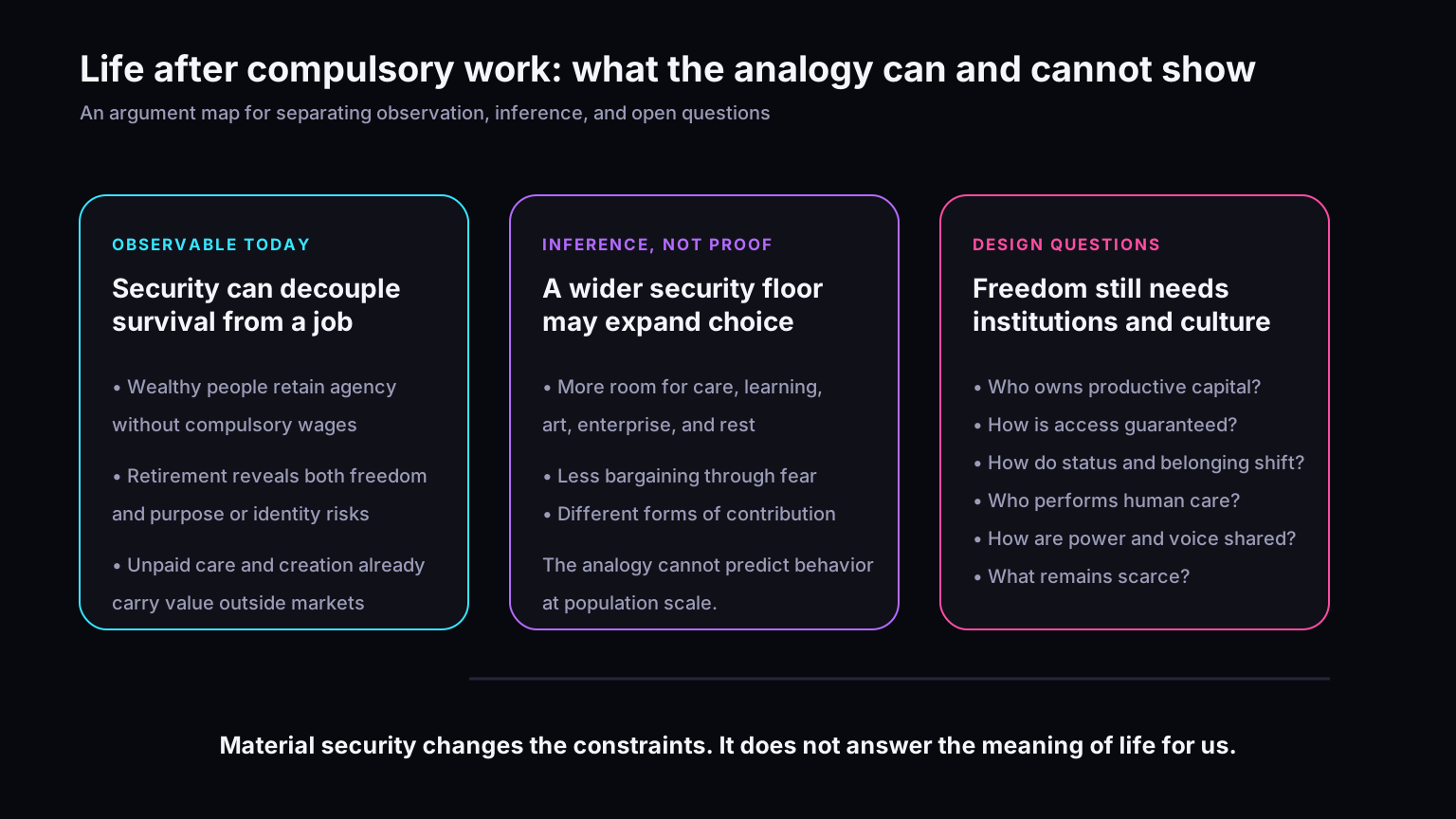
A post-work society should democratize that part of wealth: not private jets, but meaningful control over one's time.
Wealth did not abolish effort. It changed its direction#
The richest people often choose work that looks suspiciously like work.
They hold meetings, manage teams, argue about design, launch projects, compete, fail publicly, and begin again. The difference is that the project can be selected for ambition, identity, fascination, power, legacy, or play, not only because the electricity bill is due.
This distinction matters because the standard defense of compulsory employment assumes that fear is the primary motor of human action.
It is a motor. It is not the only one.
People voluntarily do things that are difficult, repetitive, and sometimes painful:
- train for marathons;
- raise children;
- maintain open-source projects;
- master instruments;
- volunteer in disasters;
- care for relatives;
- study languages no employer requested;
- build games that may never sell;
- spend nights understanding stars, engines, histories, plants, or code.
The activity remains demanding. What changes is authorship.
The real luxury is authorship over time#
Official time-use data does not measure "purpose" directly, but it shows how strongly paid employment structures a day. The U.S. Bureau of Labor Statistics tracks how people divide time among paid work, care, household activity, education, leisure, and sleep. Employment status shifts that allocation by hours, not minutes.
The moral fact hiding inside the spreadsheet is simple:
Your job does not only buy your labor. It organizes your waking life.
It decides when you rise, where you may be, how long your attention belongs elsewhere, which risks are affordable, and how much energy remains for everything you claim matters.
"Just give people money" is an incomplete picture of a post-work transition. Security matters. So does time sovereignty.
A paycheck is not the same thing as purpose#
We have fused several different things into one institution:
- income;
- daily structure;
- identity;
- social contact;
- recognition;
- mastery;
- contribution;
- status;
- a reason to get out of bed.
Then we call the bundle "a job" and assume removing any part removes all of it.
It does not have to.
The OECD's well-being framework measures life through multiple dimensions rather than income alone. Self-determination theory, an influential psychological framework, emphasizes autonomy, competence, and relatedness as important conditions for motivation and well-being.
Those are not guaranteed by wealth, and they are not guaranteed by a job. But they give us a better design brief than "keep everyone busy."
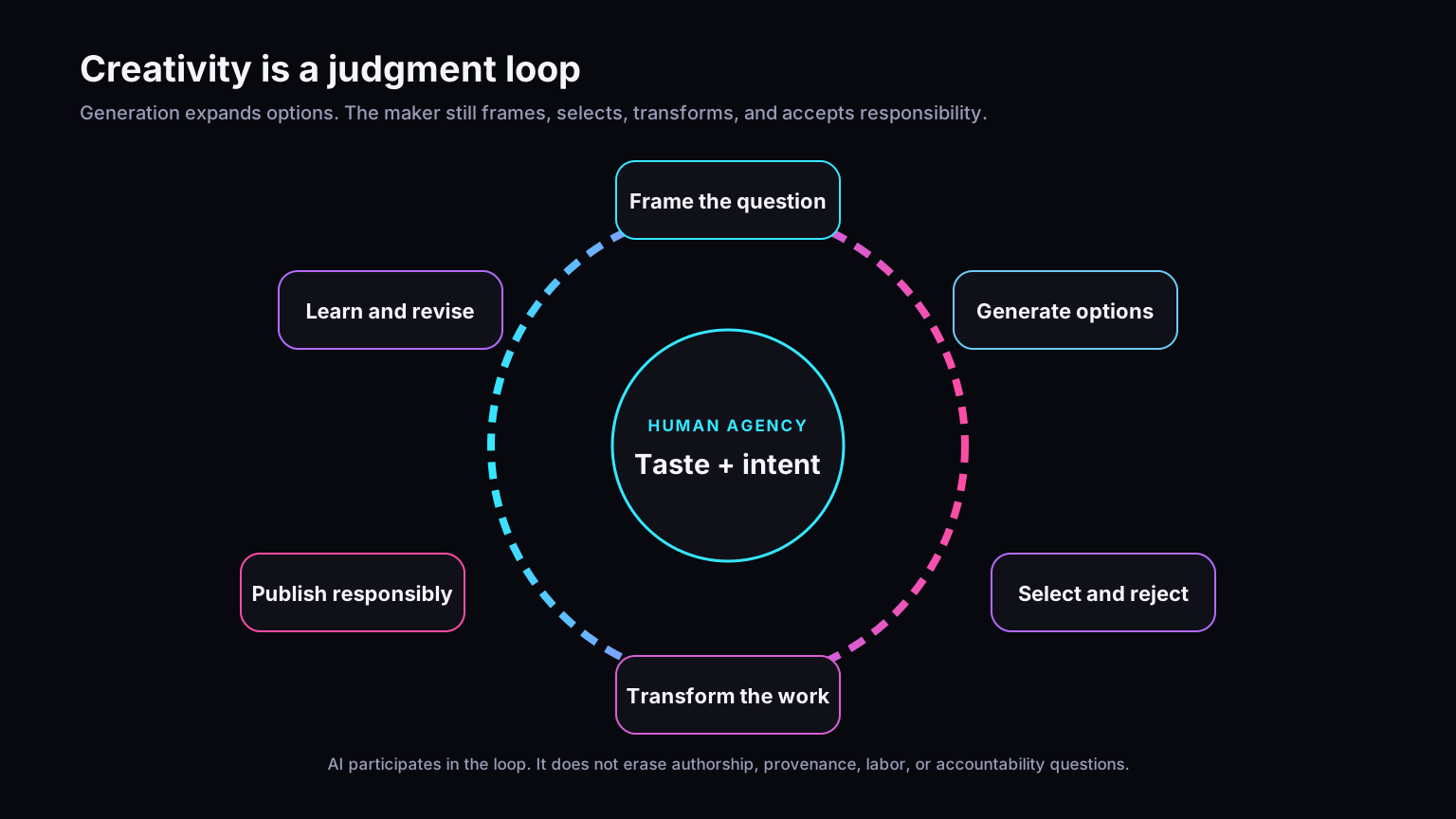
In a high-automation society:
- Autonomy means having meaningful choice over projects and time.
- Competence means access to learning, tools, feedback, and real challenges.
- Relatedness means belonging to people and institutions that notice whether you exist.
A bank transfer can support these conditions. It cannot manufacture them.
The poor are not less curious. They are more interrupted#
The ugliest assumption in the post-work debate is that only people who have already succeeded deserve freedom.
We see a wealthy person leave a career to make films and call it reinvention.
We see a poor person without a job and call it failure.
One gets a sabbatical. The other gets a gap in the résumé.
The difference is not necessarily talent or desire. It is runway, health, housing, networks, education, and the ability to survive a bad month.
The World Inequality Report 2026 documents how unevenly assets are held. Wealth buys more than consumption. It buys the capacity to wait, refuse, recover, experiment, and be wrong without immediate catastrophe.
Universal Basic Abundance should make that experimental runway less hereditary.
Current AI is not the post-work world#
We need to keep the clocks separate.
The ILO's global exposure analysis does not show that nearly all work has vanished. It shows that generative AI can affect tasks inside many occupations, with transformation presently more likely than full automation for most of them.
So the responsible present-tense argument is not:
Work is over.
It is:
If automation weakens the connection between labor and production, we should start designing the institutions that currently hide inside employment.
Waiting until people lose income, structure, status, and community at once would be an act of political laziness.
The bad version of life after work#
There is a genuinely dark path.
People lose jobs while ownership remains concentrated. They receive enough money to remain quiet but not enough agency to shape their world. Their time is captured by addictive feeds, synthetic entertainment, automated persuasion, and platforms designed to monetize emptiness.
That is not freedom from work.
It is unemployment inside a shopping mall that never closes.
A society can provide calories and still starve people of dignity, agency, privacy, challenge, and recognition.
That danger makes ownership of the AI economy central. If a few institutions own production, intelligence, culture, and the channels through which people seek meaning, "free time" can become another extractive market.
The better version: contribution without coercion#
The alternative is not forcing everyone into an approved hobby.
It is building many ways to contribute:
- local care networks;
- open science;
- public-interest technology;
- community art and music;
- ecological restoration;
- mentoring and teaching;
- citizen assemblies;
- independent research;
- cooperatives;
- craft;
- sport;
- spiritual and cultural practice;
- projects we cannot name yet.
Some will be paid. Some will produce reputation. Some will create belonging. Some will remain beautifully useless.
Survival should no longer decide which activities count as real.
We will still need structure#
A job provides an externally imposed rhythm. Without it, some people flourish and some drift.
Preserving unnecessary work as social theater is the wrong answer. A better transition needs:
- Learning throughout life, not one compressed educational phase before forty years of work.
- Public studios, laboratories, workshops, compute, and creative tools, so curiosity has somewhere to go.
- Communities of practice, where people develop mastery and receive honest feedback.
- Civic roles with real authority, not ceremonial volunteering.
- Care infrastructure, because raising, healing, and supporting people are contributions even when markets underprice them.
- Mental-health and transition support, because identity shocks are real.
- Portable reputation, so contribution can be visible without becoming a new survival score.
The challenge is to supply structure without rebuilding coercion.
Rich people are not the model. Choice is the clue#
The rich are a terrible universal template.
They have distorted incentives, unusual networks, and power that cannot simply be copied. Some use freedom generously. Some use it to accumulate more control. Some keep working because competition itself became the addiction.
But their lives reveal one fact worth stealing:
When paid employment becomes optional, human action does not disappear. It changes motive, direction, and ownership.
That is a clue, not proof.
What would you do if survival stopped chasing you?#
This question sounds soft until you realize it is an economic design question.
What would you learn if the learning did not need an immediate return?
Who would you care for if care did not make you poor?
What would you build if failure did not threaten your home?
Which problem would you follow for ten years if an employer did not need to understand it this quarter?
Some people will answer with rest. Some with family. Some with a company, an album, a theorem, a garden, a movement, or a game.
The goal is not to predict every answer.
The goal is to let more people own the question.
Sources and evidence
Product claims are attributed to their publishers. Measurements and projections retain their original scope, date, and uncertainty.
- Measured findingofficial time-use statisticsAmerican Time Use Survey: 2025 Results
U.S. Bureau of Labor Statistics · Published Jun 25, 2026 · Accessed Jul 26, 2026
Supports: employment status is associated with large differences in how people allocate daily time.
- Measured findingpeer-reviewed psychological frameworkSelf-Determination Theory and the Facilitation of Intrinsic Motivation, Social Development, and Well-Being
American Psychologist · Published Jan 1, 2000 · Accessed Jul 26, 2026
Supports: autonomy, competence, and relatedness are central to motivation and well-being.
- Measured findinginternational well-being indicatorsHow's Life? 2024
OECD · Published Nov 5, 2024 · Accessed Jul 26, 2026
Supports: well-being is multidimensional and cannot be reduced to income or employment.
- Measured findingglobal distribution datasetWorld Inequality Report 2026
World Inequality Lab · Accessed Jul 26, 2026
Supports: freedom from labor-market dependence is distributed very unequally.
- Measured findinginternational labour analysisGenerative AI and Jobs: A Refined Global Index of Occupational Exposure
International Labour Organization · Published May 20, 2025 · Accessed Jul 26, 2026
Supports: current AI exposure should not be described as the end of work.
Article changelog
- Jul 26, 2026: Revised the title's metaphor into a bounded argument, separated wealth from well-being, and added evidence on time use, autonomy, and present-day labor exposure.
- Jun 5, 2026: Original essay published on Medium.
Questions
Are rich people actually a scientific test of life after work?+
No. The title is a metaphor, not a randomized experiment. Wealthy people differ from the wider population in many ways. Their lives still show one useful thing: when survival is less dependent on a paycheck, people often continue pursuing projects, status, mastery, care, and curiosity.
Does removing compulsory work automatically create purpose?+
No. Jobs also provide structure, identity, social contact, and recognition. A humane transition would need institutions for learning, contribution, community, care, and democratic participation rather than assuming purpose appears automatically.
Is AI already ending work?+
No. Current evidence shows uneven task exposure and changing workflows, not the disappearance of nearly all jobs. This essay considers what a later high-automation society would need to learn from the present.
What is the main policy lesson?+
Do not treat income alone as the entire transition. People need a secure material floor, but they also need agency over time, access to communities and tools, opportunities to develop mastery, and ways to contribute that are not limited to paid employment.