Evidence-based proposed framework
Universal Basic Abundance: A Working Definition and Testable Framework
A rigorous working definition of Universal Basic Abundance, the conditions required to deliver it, the bottlenecks between AGI and access, and the claims that remain uncertain.
- Published
- Reviewed
- Next review
- Freshness
- active
Intelligence can expand productive possibility; infrastructure, ownership, institutions, and distribution determine whether that possibility reaches people.
Concept artwork generated for Akoum.me with OpenAI image generation; editorial selection and caption by Muhamad J. Akoum.
Working definition
What is universal basic abundance?
Universal Basic Abundance is a proposed framework in which everyone receives reliable access to a politically specified and measurable floor of essential material, digital, and productive capabilities. High automation may enable it, but infrastructure, ownership, governance, distribution, and resilience determine whether abundance reaches people.
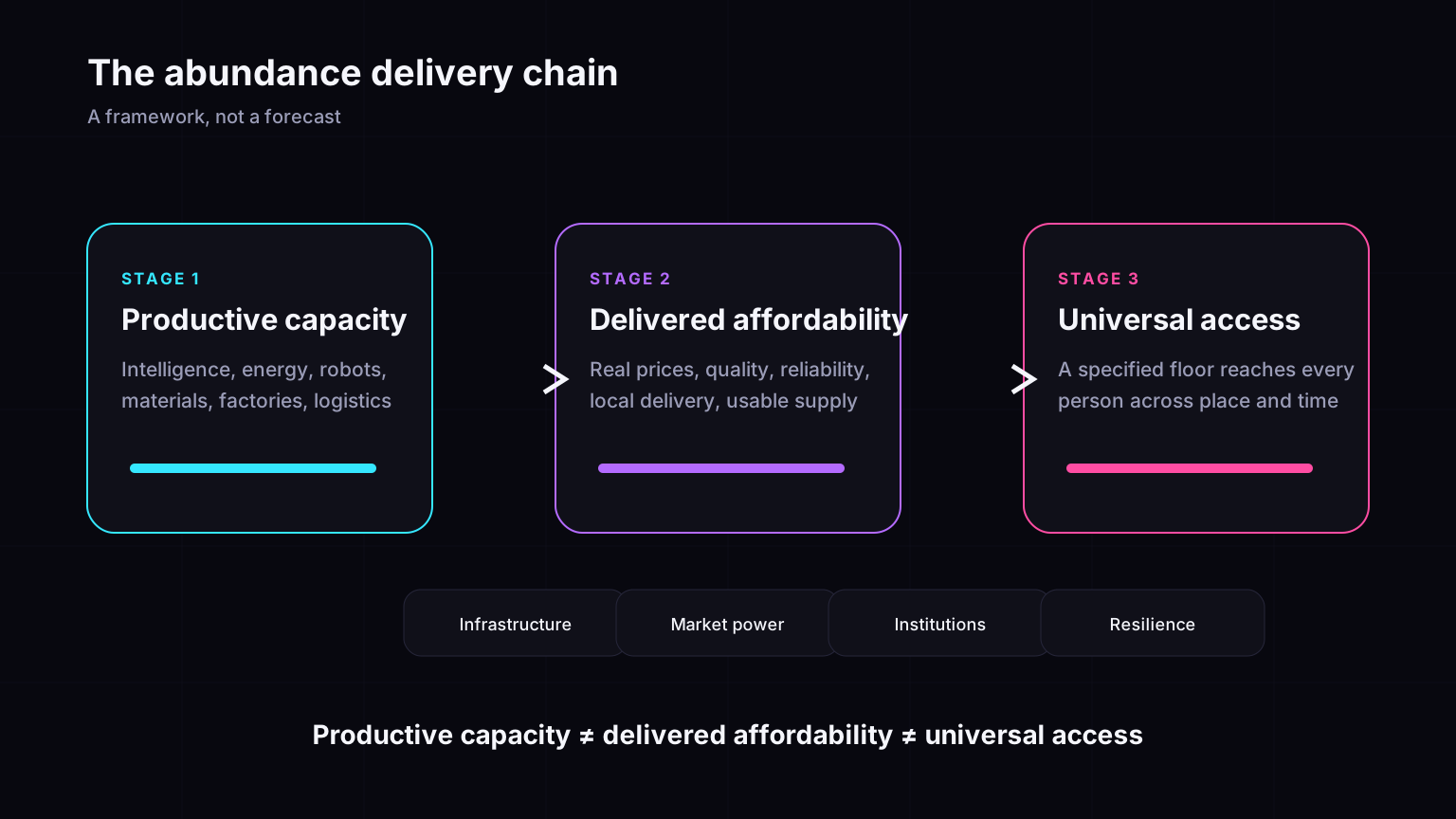
Productive capacity ≠ delivered affordability ≠ universal access.
01
What the framework claims
UBA is a proposal about guaranteed access, not a prediction that more capable AI will automatically make goods free.
The basic floor should be specified democratically and measured as reliable access to essential material, digital, and productive capabilities, rather than as an undefined promise of plenty.
Candidate domains include food, housing, healthcare, energy, connectivity, education, mobility, and a usable share of computational capability. The exact bundle is a political choice, not a technical constant.
Universal Basic Abundance does not require literal post-scarcity; it requires a dependable floor whose availability is not defeated by price, location, legal exclusion, outages, or concentrated control.
The inference follows from the difference between producing more and distributing reliable access.
The abundance delivery chain separates how much can be produced from what is affordable in practice and what every person can reliably access.
02
The causal chain from AI to access
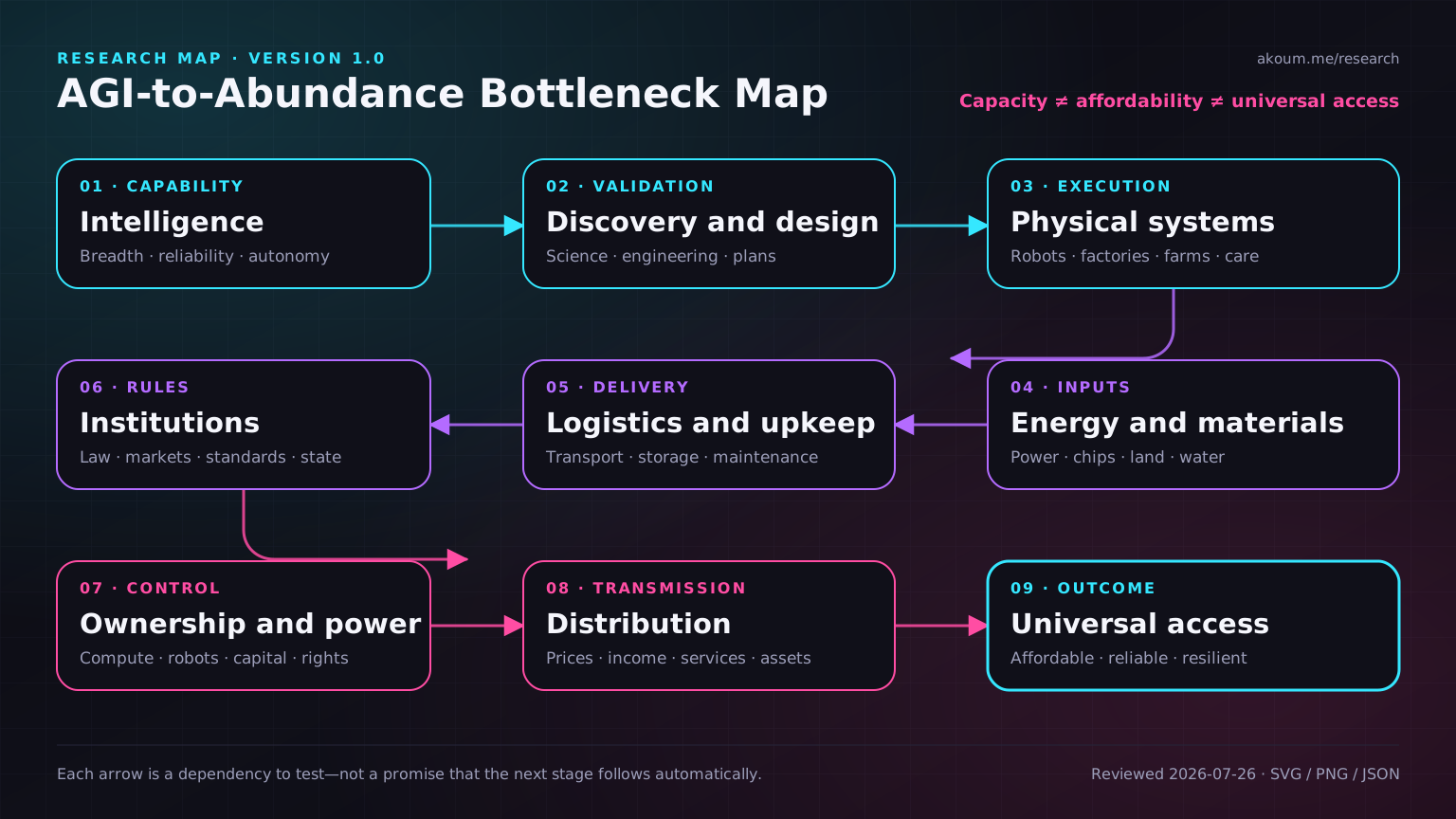
Intelligence is one input. The chain also needs machines, energy, materials, logistics, institutions, ownership rules, and distribution systems.
OpenAI describes its current task as making advanced AI abundant, affordable, safe, useful, and easy enough for every person and organization to benefit.
That is an institutional objective, not evidence that universal access has already been achieved.
Anthropic’s Economic Policy Framework considers a scenario in which AI creates unprecedented abundance while substituting for labor, making distribution rather than production the central economic challenge.
Anthropic explicitly says the pace of capability progress and diffusion is uncertain.
Even highly capable general intelligence would not by itself build homes, expand power grids, move food, allocate land, establish entitlements, or make infrastructure resilient.
Each step needs physical capital or institutional action. The bottleneck map makes those dependencies inspectable rather than hiding them inside the word abundance.
Nine dependencies stand between capable intelligence and an observable universal-access outcome.
03
What would make UBA measurable
A serious UBA claim needs coverage, affordability, quality, reliability, agency, and resilience indicators for every included domain.
A UBA scorecard should report the share of people with affordable, timely, safe, and dependable access to each guaranteed capability.
Production totals alone are insufficient. A country can produce abundant energy or food while specific households remain priced out or physically disconnected.
Every metric needs a denominator and a distribution: who is covered, where, at what quality, for how long, and with what failure rate.
A national average can conceal exclusion by income, geography, disability, migration status, or network availability.
The floor should expand agency rather than require submission to a single employer, platform, or political authority.
Access that can be withdrawn arbitrarily is a dependency, not a reliable universal floor.
04
Ownership is a transmission mechanism
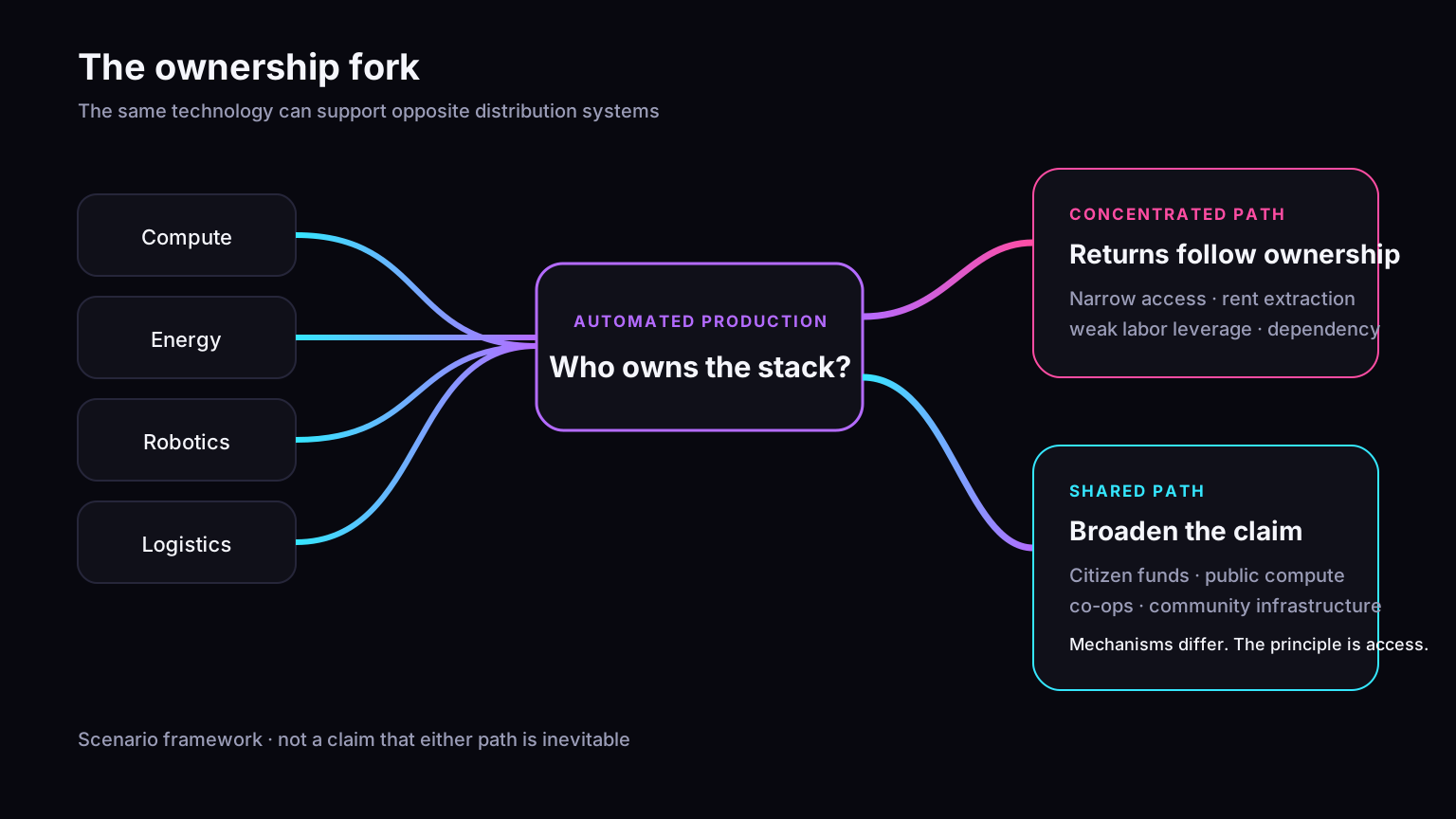
Who owns compute, robots, energy systems, land, data rights, and financial claims shapes whether productivity gains lower costs broadly or accumulate narrowly.
OpenAI’s charter commits to broadly distributed benefits and avoiding undue concentration of power; its 2026 plan says a good AI future cannot leave capability and upside controlled by a small number of institutions.
These are stated commitments. Their real-world sufficiency must be evaluated separately.
Possible distribution mechanisms include lower market prices, public services, cash transfers, universal assets, social wealth funds, broad equity ownership, and public or cooperative infrastructure.
These mechanisms are complements or alternatives with different effects on agency, political durability, and exposure to inflation.
The same productive technology can support sharply different access outcomes depending on ownership and the claims people hold on output.
05
Counterarguments the framework must survive
UBA should be judged against hard objections rather than presented as an inevitable consequence of AI progress.
Lower costs in one layer can increase demand and create new bottlenecks in energy, chips, land, water, skilled maintenance, or governance capacity.
Efficiency does not guarantee lower total resource use or equal access.
If productive infrastructure remains highly concentrated, output may become abundant while access stays conditional, surveilled, or expensive.
UBA therefore needs institutional and ownership tests in addition to technical capability tests.
Material security does not resolve questions of meaning, status, care, participation, or political voice in a society with much less paid labor.
Those outcomes depend on culture and institutions and cannot be inferred from model benchmarks.
Direct answers
Is Universal Basic Abundance the same as Universal Basic Income?
No. UBI guarantees cash. UBA proposes a measurable floor of access to specified capabilities and may use cash, services, assets, dividends, price reductions, or a mixture of mechanisms.
Does AGI automatically create abundance?
No. AGI may increase discovery and coordination capacity, but physical production, energy, materials, logistics, institutions, ownership, and distribution remain separate constraints.
Limitations
- Universal Basic Abundance is a proposed analytical framework, not an established economic program or a claim of authorship over the phrase.
- The framework does not provide a universal list of essentials; the guaranteed bundle and thresholds require legitimate political choice.
- Current AI capability trends do not establish that AGI, ASI, robotics at scale, or low-cost physical production will arrive on any particular timeline.
- The cited laboratory publications describe institutional definitions, goals, and scenarios; they are not independent proof that those goals will be achieved.
Visible evidence ledger
Sources
Tier 1 means official documentation, policy, law, or statistics. Tier 2 means peer-reviewed research or a transparent dataset. Higher-numbered tiers provide context and are not used to establish volatile product facts.
- Tier 1Attributed definitionBuilt to benefit everyone: our plan (opens in a new tab)
OpenAI · Published · Accessed
- Tier 1ScenarioPolicy on the AI Exponential: Economic Policy Framework (opens in a new tab)
Anthropic · Publication date not stated on the source page · Accessed
- Tier 2ScenarioFrom AGI to ASI (opens in a new tab)
Google DeepMind · Published · Accessed
- Tier 1Attributed definitionOpenAI Charter (opens in a new tab)
OpenAI · Publication date not stated on the source page · Accessed
- Tier 3Attributed definitionUniversal Basic Assets (opens in a new tab)
Institute for the Future · Publication date not stated on the source page · Accessed
Cite this page
Use the reviewed date because this is a maintained reference.
Akoum, Muhamad J. “Universal Basic Abundance: A Working Definition and Testable Framework.” Akoum.me. Reviewed 2026-07-26. https://akoum.me/universal-basic-abundance
Supporting essays
Longer arguments and field notes that develop the positions on this page.
Changelog
- Published the working definition, causal chain, measurement conditions, counterarguments, and primary-source ledger.