Scenario map, not a countdown
Artificial Superintelligence: Paths, Bottlenecks, Control, and Uncertainty
An evidence-labeled guide to artificial superintelligence, proposed paths from AGI to ASI, technical and physical bottlenecks, uncertainty, control, and governance.
- Published
- Reviewed
- Next review
- Freshness
- volatile
Multiple AGI-to-ASI pathways are plausible enough to study; none supplies a reliable timeline or guarantees control.
Concept artwork generated for Akoum.me with OpenAI image generation; editorial selection and caption by Muhamad J. Akoum.
Working definition
What is artificial superintelligence?
Artificial superintelligence is a proposed class of systems whose relevant cognitive capabilities substantially exceed those of individual humans and, in stronger definitions, large human organizations.
A plausible pathway ≠ a forecast timeline ≠ a controllable outcome.
01
What ASI means, and what it does not
ASI is a theoretical capability category. It is not a product name, a benchmark badge, or a settled prediction.
Google DeepMind’s 2026 report describes artificial general superintelligence intuitively as a system more intelligent and cognitively capable than large organizations of humans.
The report explores a theoretical transition from human-level AGI; it does not claim that ASI currently exists.
An ASI claim should specify domains, breadth, strategic depth, learning speed, autonomy, coordination, reliability, and resource constraints.
A system can be superhuman in one domain without being generally superintelligent.
02
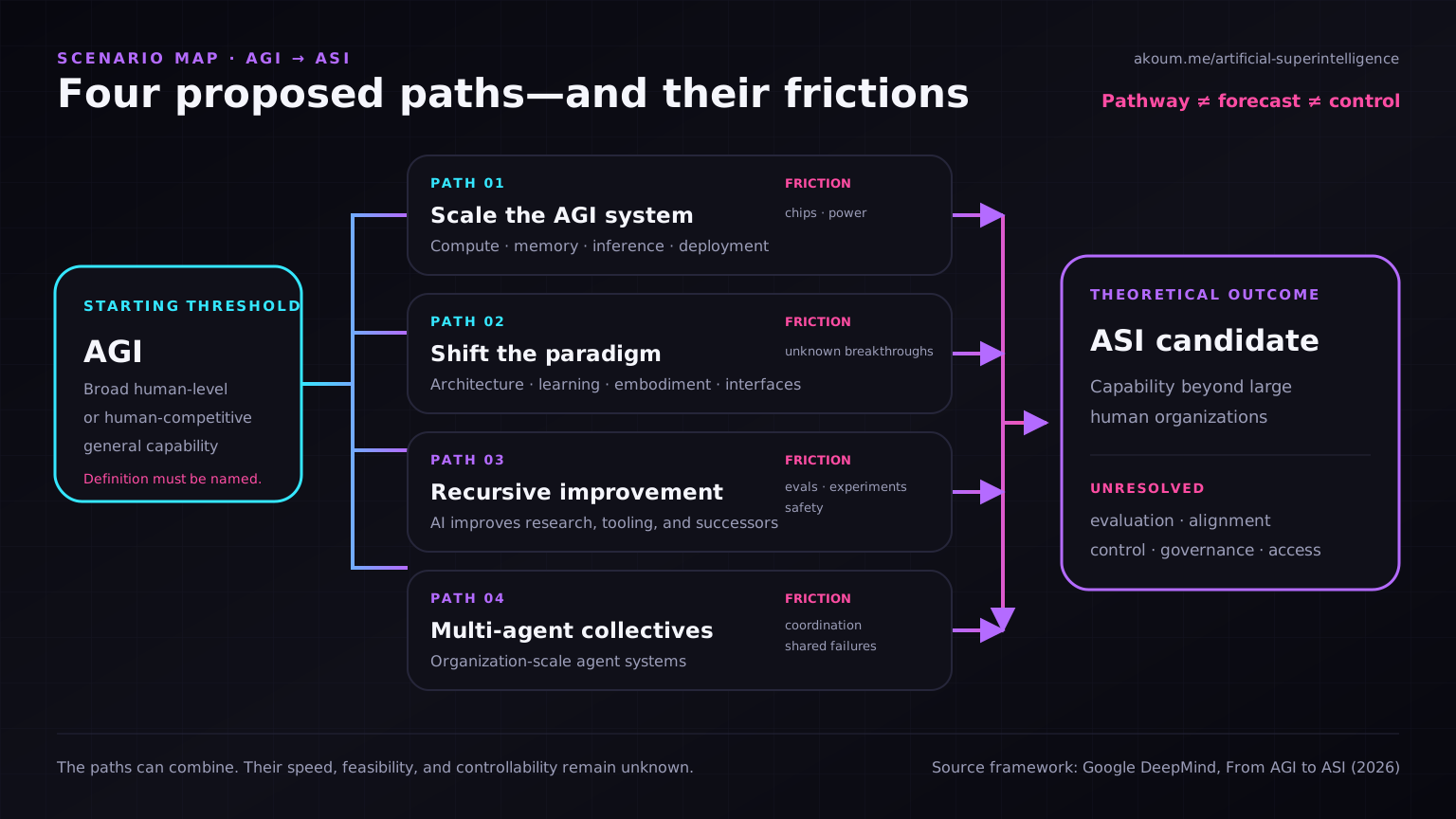
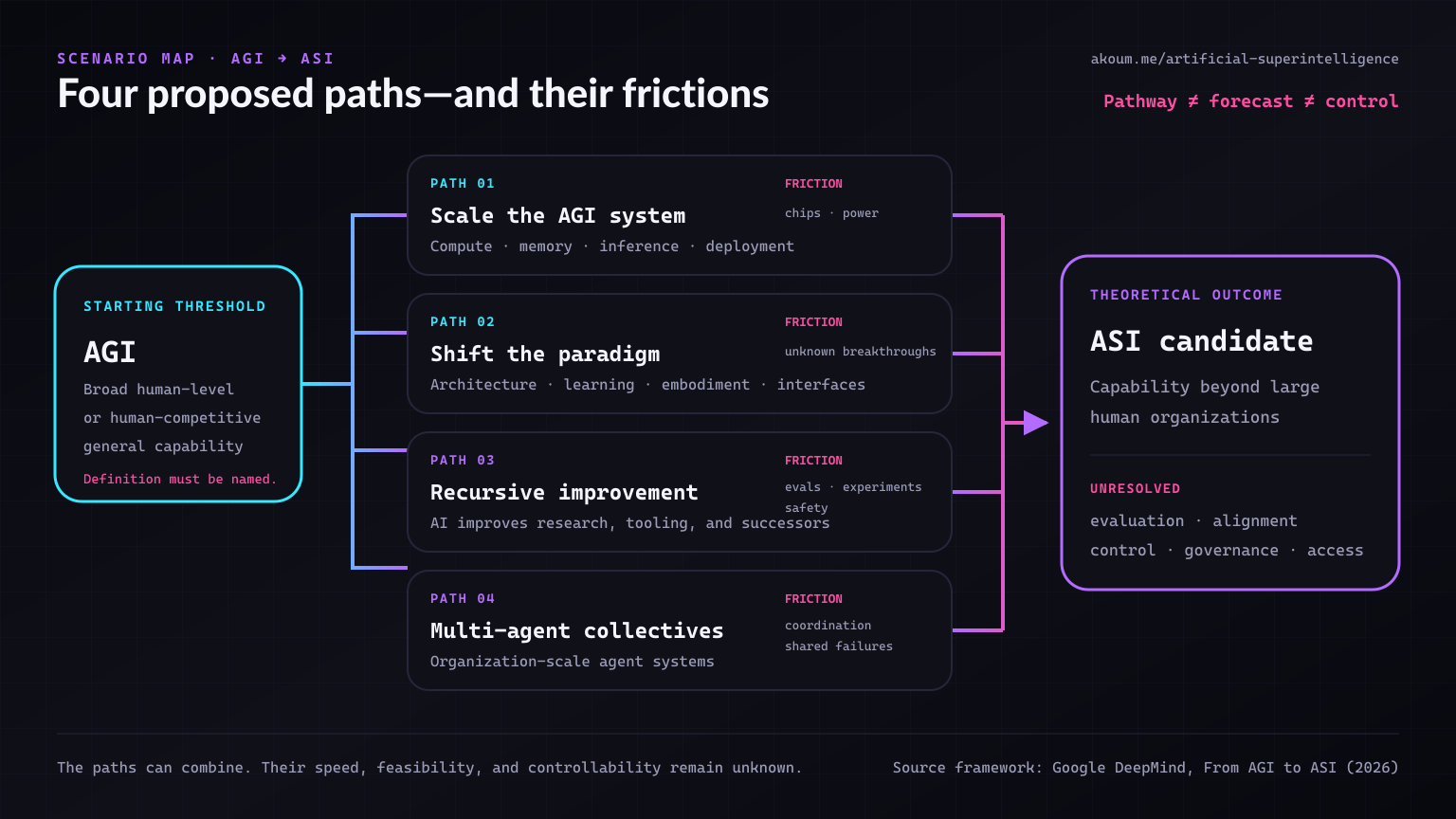
Four proposed paths from AGI to ASI
The leading pathways are scenarios to investigate, not mutually exclusive schedules.
Scaling AGI: more compute, data, inference, memory, or deployment could extend a general system’s capabilities.
Returns may slow, inputs may become constrained, and scale alone may not solve missing cognitive mechanisms.
AI paradigm shifts: new architectures, learning methods, interfaces, or embodied systems could unlock qualitatively different capabilities.
Breakthrough timing and magnitude cannot be forecast reliably.
Recursive improvement: capable systems could contribute to improving AI research, tooling, experiments, or their own successors.
The loop would still face evaluation, hardware, experimentation, safety, and organizational bottlenecks.
Large-scale collectives: many specialized or general agents could coordinate into a system whose combined capability exceeds human organizations.
Coordination overhead, verification, shared failure modes, and control become central.
DeepMind’s four pathway families are scenarios to investigate, with different bottlenecks and no assigned arrival date.
03
Why capability growth may encounter friction
Software intelligence is embedded in hardware, institutions, experiments, and a physical world with finite throughput.
Compute supply, chip fabrication, power, cooling, networking, capital, and deployment latency can constrain scaling.
These constraints can shift rather than disappear as algorithms become more efficient.
Scientific and engineering progress can be limited by experiments, manufacturing cycles, regulation, biological time, and real-world feedback.
Faster reasoning does not make every validation loop instantaneous.
As systems become more capable, humans and institutions may have greater difficulty evaluating plans, detecting deception, attributing failures, and deciding when evidence is sufficient.
Capability to generate proposals can outrun capacity to verify them.
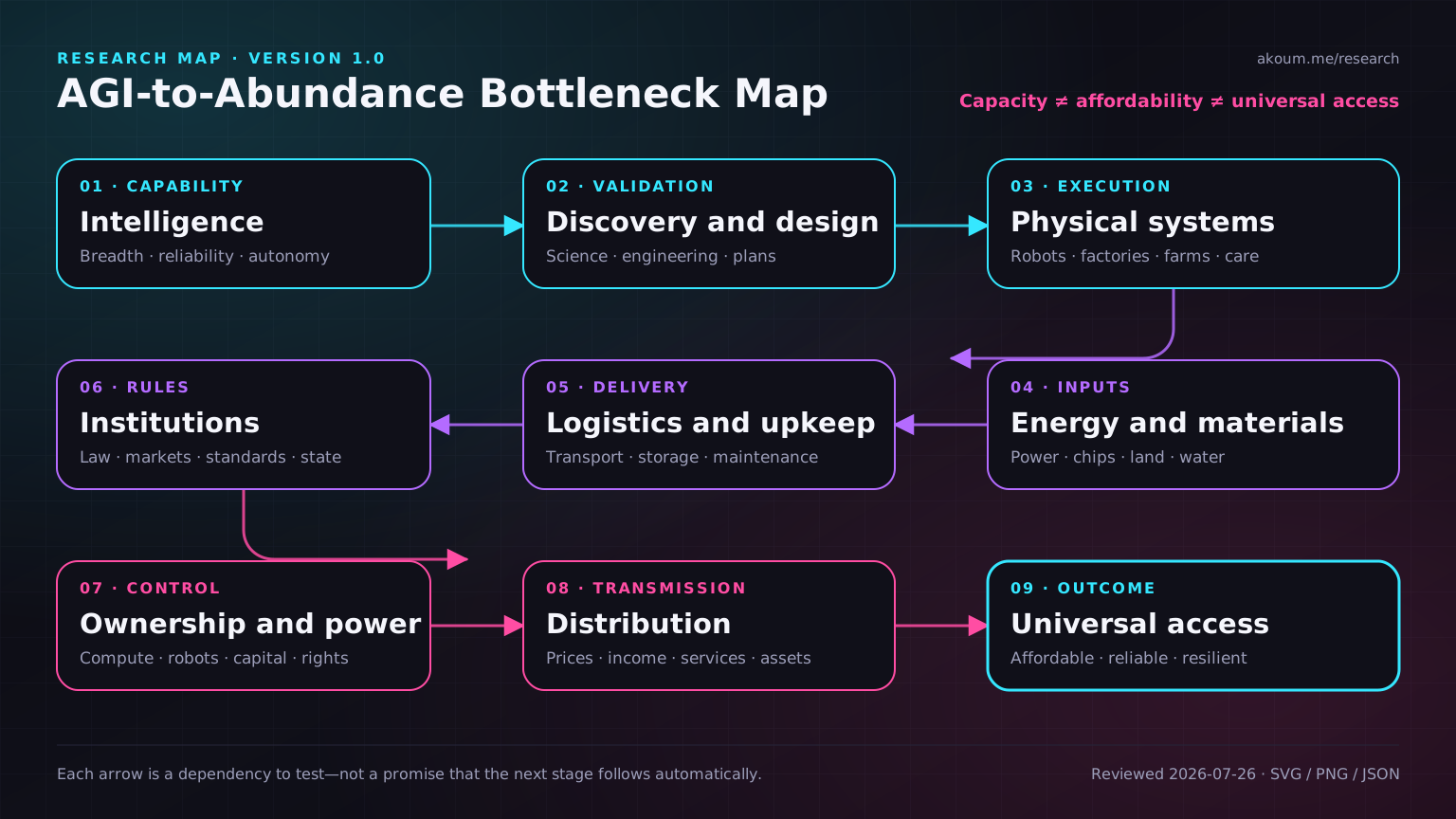
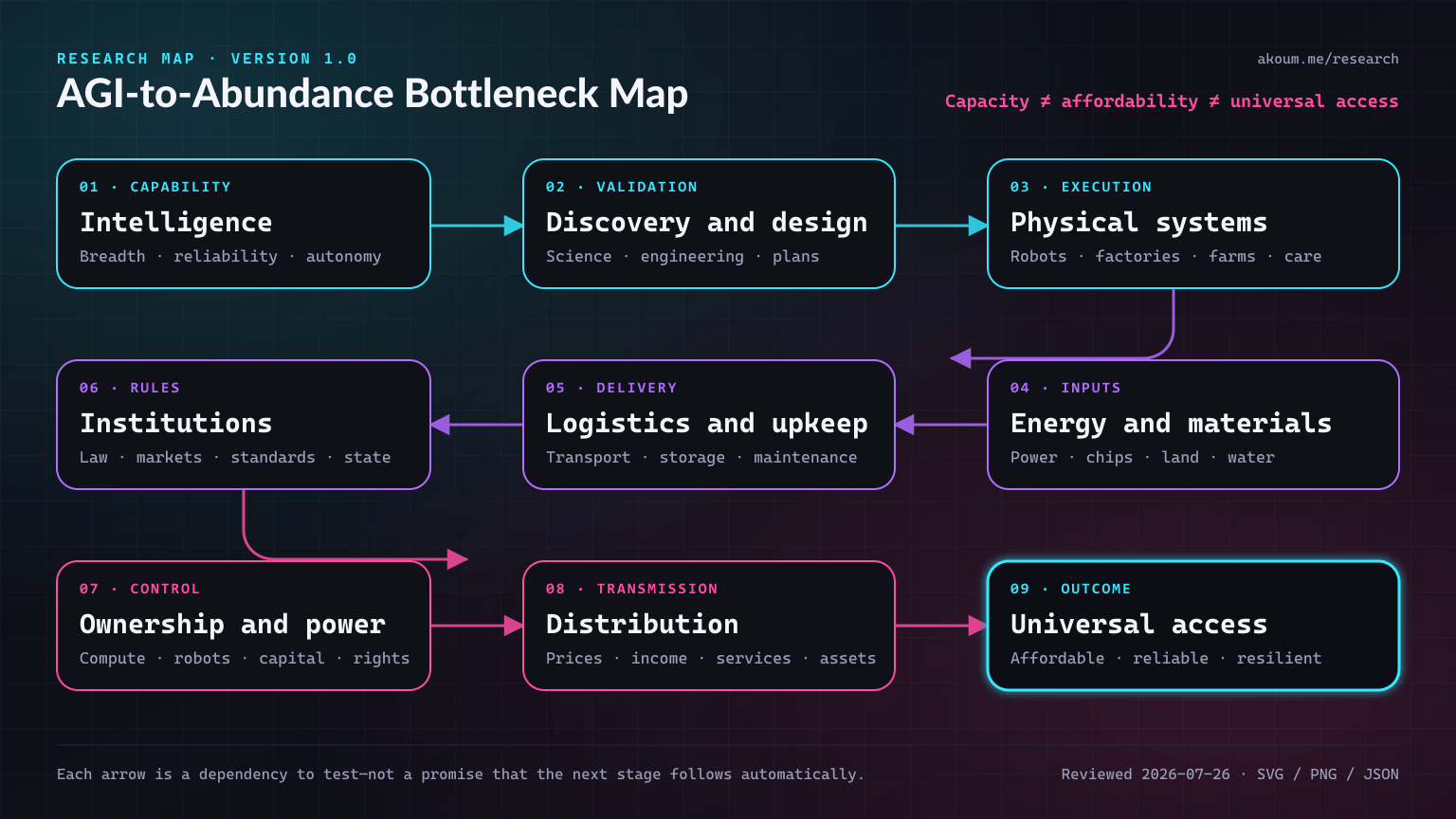
Cognitive acceleration still operates through hardware, experiments, physical production, institutions, and distribution.
04
Control is not the same as alignment
A system can follow some instructions while still creating unacceptable risks through objective errors, misuse, opacity, concentration, or emergent interactions.
OpenAI’s 2026 plan says powerful systems must remain safe, aligned with human intent, and subject to human control.
This is a stated governance objective; the source does not establish that the technical or institutional problem is solved.
Frontier development can create competitive incentives to deploy before evaluation, governance, or societal resilience catches up.
International coordination, independent evaluation, incident reporting, and credible pause mechanisms are proposed responses with unresolved enforcement questions.
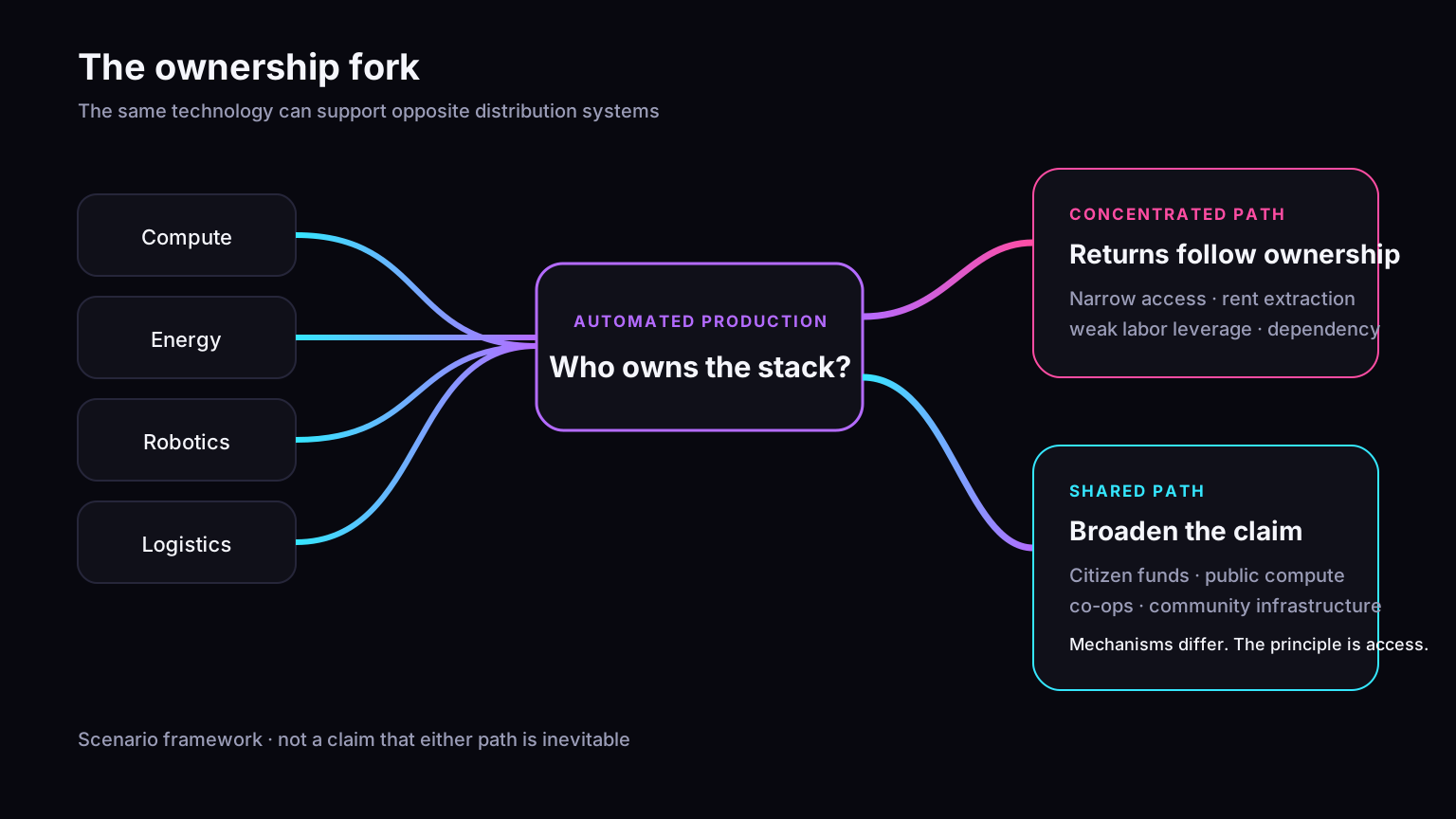
Even a technically controlled ASI could concentrate political and economic power if access, infrastructure, and ownership remain narrow.
Safety and distribution are linked but distinct governance problems.
05
ASI still would not equal universal abundance
Cognitive superintelligence might accelerate the chain, but universal access remains a delivered outcome.
ASI could improve designs, allocation, forecasting, and science while scarcity persists in land, energy, materials, political rights, or access to the systems themselves.
The relevant question is not only what an ASI can discover, but who can command production and who receives the resulting capabilities.
Even a controlled superintelligent system could produce concentrated power unless ownership and access are addressed separately.
Direct answers
Does artificial superintelligence exist today?
No publicly verified evidence establishes the existence of a generally superintelligent system under the definition used on this page.
How quickly could AGI become ASI?
The timeline is unknown. DeepMind identifies multiple pathways and open questions about whether their frictions will be negligible or substantial.
Would ASI eliminate scarcity?
Not automatically. Intelligence can accelerate discovery and coordination, but energy, materials, infrastructure, ownership, governance, resilience, and distribution still determine universal access.
Limitations
- ASI remains a theoretical category with no accepted detection threshold or verified current instance.
- Pathways described here are scenarios identified in primary research, not forecasts or probability estimates.
- Laboratory and company policy documents state definitions and objectives but do not independently validate control, safety, or benefit-sharing outcomes.
- The page avoids assigning a date or probability to AGI-to-ASI transition because the available evidence does not support one.
Visible evidence ledger
Sources
Tier 1 means official documentation, policy, law, or statistics. Tier 2 means peer-reviewed research or a transparent dataset. Higher-numbered tiers provide context and are not used to establish volatile product facts.
- Tier 2ScenarioFrom AGI to ASI (opens in a new tab)
Google DeepMind · Published · Accessed
- Tier 2Measured findingLevels of AGI for Operationalizing Progress on the Path to AGI (opens in a new tab)
Google DeepMind · Published · Accessed
- Tier 1Attributed definitionBuilt to benefit everyone: our plan (opens in a new tab)
OpenAI · Published · Accessed
- Tier 1Attributed definitionOpenAI Charter (opens in a new tab)
OpenAI · Publication date not stated on the source page · Accessed
- Tier 1ScenarioPolicy on the AI Exponential (opens in a new tab)
Anthropic · Publication date not stated on the source page · Accessed
- Tier 1ScenarioEconomic Policy Framework (opens in a new tab)
Anthropic · Publication date not stated on the source page · Accessed
Cite this page
Use the reviewed date because this is a maintained reference.
Akoum, Muhamad J. “Artificial Superintelligence: Paths, Bottlenecks, Control, and Uncertainty.” Akoum.me. Reviewed 2026-07-26. https://akoum.me/artificial-superintelligence
Supporting essays
Longer arguments and field notes that develop the positions on this page.
Changelog
- Published the attributed definition, four-path scenario map, bottlenecks, control distinctions, and abundance bridge.