Who Owns the AI Economy? Robots, Compute, and the Abundance Question
AI abundance will not distribute itself. This analysis follows the ownership stack from models and compute to energy, robots, data, platforms, and public infrastructure, then examines institutional options for sharing the gains.
By Muhamad J. Akoum Senior Product Engineer
- AI economy
- AI ownership
- compute
- robotics
- Universal Basic Abundance
- inequality
- AI governance
Part of the Universal Basic Abundance evidence cluster.
Evidence reviewed: Jul 26, 2026
Next review: Oct 24, 2026
Freshness: fast-moving · 90-day cadence
Primary question: who will own the AI economy
Editorial role: ownership-analysis
Editorial status: Evidence-backed analysis and policy proposal. Present-day labor findings are kept separate from post-AGI scenarios. Institutional options are proposals, not forecasts or financial advice.
The loudest question about AI is:
What will the models be able to do?
The decisive question may be:
Who will own the machines that can do it?
If AI makes labor radically cheaper while ownership of models, compute, chips, energy, robots, data, and distribution remains concentrated, the result is not automatic abundance.
It is abundance behind a tollgate.
The model is not the economy#
A model can be astonishing and still be one layer in a much larger system.
To turn intelligence into economic power, someone needs:
- chips and data centers;
- reliable electricity and grid connections;
- capital to build and operate infrastructure;
- data and permission to use it;
- robots, machines, vehicles, or human operators;
- cloud and software platforms;
- access to customers and institutions;
- legal rights, standards, and political legitimacy.
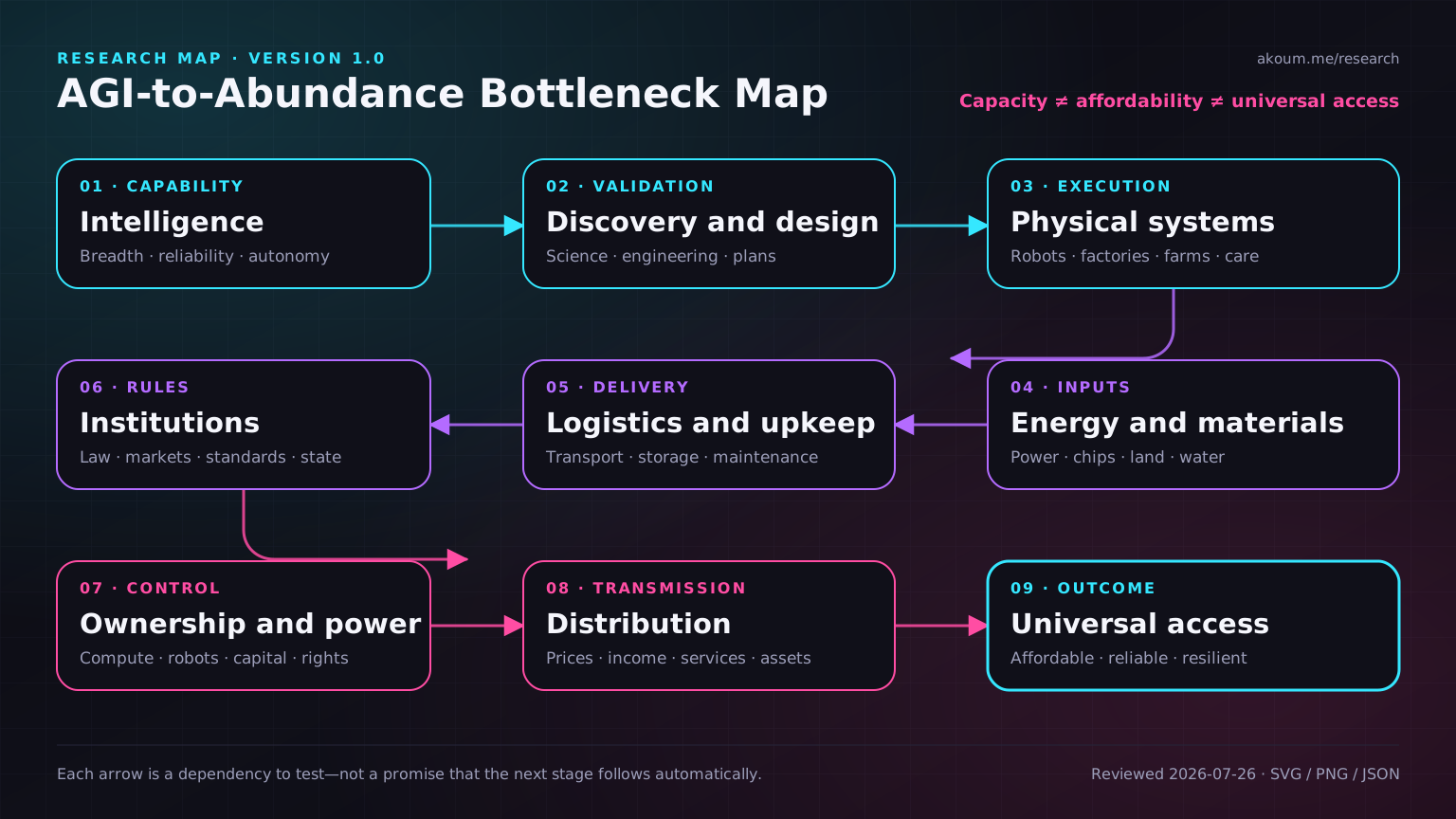
An open model running on a closed compute market is not fully open in practice. A cheap agent connected to a privately controlled robot fleet is not a universal production system. A public model without energy, deployment talent, or reliable institutions may remain a demo.
The ownership analysis must follow the entire stack.
Layer one: models#
Frontier models are expensive to train and generally controlled by private firms. Open-weight releases broaden who can inspect, adapt, and deploy some systems, subject to license and hardware constraints.
This creates several forms of control:
- access can be priced or withdrawn;
- acceptable use can be governed by provider policy;
- model behavior can change after an update;
- developers can become dependent on one API;
- safety restrictions can be either essential protections or unaccountable private rulemaking, depending on the context.
Competition between providers helps. Portability and open standards help. Neither removes the physical layers below.
Layer two: compute and chips#
Compute turns a model from a file into a service.
The relevant questions are:
- Who can buy the accelerators?
- Who controls fabrication, packaging, networking, and cloud capacity?
- Which countries can obtain equipment?
- Who receives priority during shortages?
- Can a small organization run a competitive system without one hyperscaler?
Compute can become cheaper per unit while total capital requirements rise. Falling inference prices do not automatically democratize training or large-scale deployment.
Abundance arguments often confuse a cheaper unit with distributed ownership of the factory.
Layer three: energy#
AI infrastructure is also energy infrastructure.
The International Energy Agency projects substantial growth in data-center electricity demand and emphasizes grid bottlenecks. A company that secures generation, land, permits, cooling, and interconnection capacity has obtained more than cheap power. It has obtained the ability to expand intelligence when others cannot.
Energy contracts can become a competitive moat.
A public conversation about AI that ignores utilities, transmission, water, and local communities is discussing the software surface while someone else owns the physics.
Layer four: robots and the physical world#
Cognitive automation affects office work first because software can act directly inside software.
Physical abundance requires machines that can:
- build and maintain housing;
- produce and move food;
- manufacture goods;
- operate infrastructure;
- care for bodies;
- work safely in unpredictable environments.
Robots are capital assets. If they are owned by a narrow class, automation can reduce the bargaining power of labor while increasing the return to ownership.
The old worker owned labor but not the factory.
The post-AGI worker may compete with a factory that also thinks.
Layer five: data and operational context#
Models become economically valuable when connected to real systems:
- medical records;
- logistics histories;
- industrial telemetry;
- customer relationships;
- legal documents;
- workflows and tacit organizational knowledge.
The owner of context can often outperform the owner of a generic model.
This has two implications.
First, privacy and data rights are economic rights. Second, institutions that accumulated data through public activity should not automatically convert it into an exclusive private moat.
Making every record public would create another failure. Access, consent, interoperability, and public return need governance.
Layer six: distribution#
The best system does not necessarily win.
The system already inside the operating system, cloud account, workplace suite, phone, school, hospital, or procurement contract may win.
Distribution controls:
- what people discover;
- which defaults are difficult to change;
- who can reach customers;
- who pays switching costs;
- whose errors become society's errors.
An abundance policy concerned only with model benchmarks can miss the platform deciding which model billions of people encounter.
Layer seven: finance and institutions#
AI infrastructure requires capital, insurance, permits, standards, liability rules, procurement, and political support.
The state is already inside the market through research funding, education, infrastructure, intellectual-property law, public data, energy regulation, and national security.
Government already touches the AI economy.
It is whether public contribution produces a public return.
What current labor evidence actually says#
The present is not yet the post-work scenario.
The International Labour Organization finds broad but uneven occupational exposure and treats job transformation as more likely than full replacement for most occupations today.
Anthropic's March 2026 study constructs an observed-exposure measure from Claude usage. It reports no systematic increase in unemployment in more exposed occupations in its analysis, while finding suggestive evidence of slower hiring for younger workers in exposed fields. The authors label limitations; it is not a national causal verdict.
The IMF describes both complementarity and substitution and warns that rising returns to capital can worsen inequality.
The evidence supports a narrower conclusion:
The distributional outcome is open, and ownership is one of the mechanisms that will shape it.
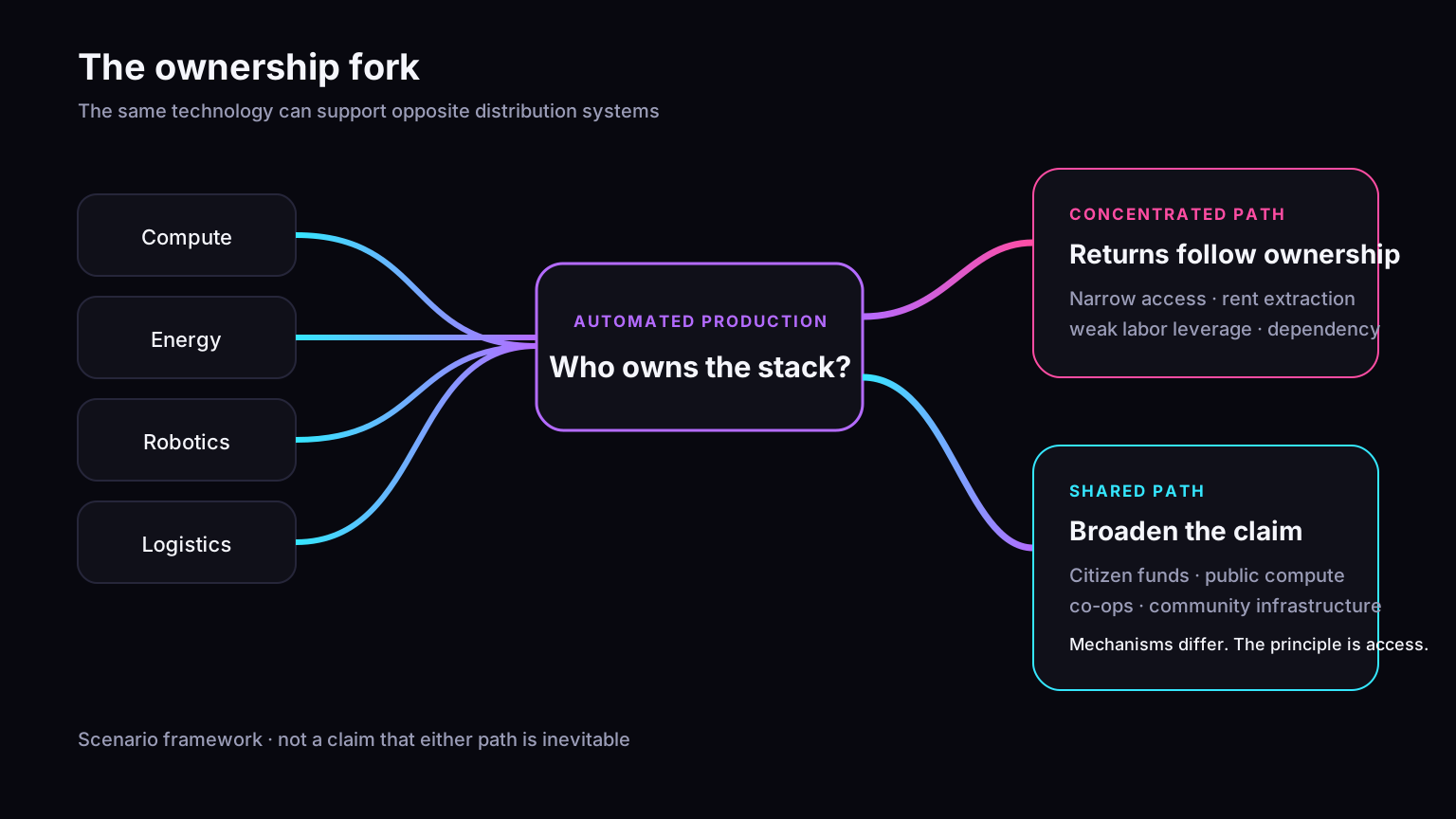
Four ownership futures#
Concentrated private ownership#
A small number of firms control the stack. They may innovate quickly and compete at the frontier, but users, workers, governments, and smaller firms become dependent on infrastructure they cannot meaningfully govern.
Benefits can still arrive through cheaper services. Power remains asymmetric.
Central state ownership#
The state controls core models and infrastructure. This can support universal services and strategic capacity, but it can also create surveillance, political allocation, stagnation, and one dangerous point of control.
Public ownership does not automatically mean democratic ownership.
Distributed market ownership#
Open models, competitive clouds, many robot providers, interoperable platforms, and aggressive competition reduce dependency.
This supports experimentation but does not guarantee a universal floor. People without purchasing power can remain excluded from a perfectly competitive market.
A universal floor with plural ownership#
Public infrastructure guarantees baseline capabilities. Private firms, cooperatives, communities, universities, and individuals continue competing and experimenting above it.
No single actor controls the whole stack. Essential access is protected through a mix of public options, standards, competition, rights, and shared ownership mechanisms.
This is the institutional direction behind Universal Basic Abundance.
Policy tools between monopoly and nationalization#
The debate often offers two buttons:
- let a few companies own everything;
- let one government own everything.
The actual design space is larger.
Public compute and public-interest models#
Universities, public agencies, researchers, local organizations, and small businesses need meaningful access to compute and capable systems, not ceremonial credits that disappear after a pilot.
Open standards and portability#
Applications should be able to move models, data, identity, tools, and audit records without being rebuilt around one provider.
Competition and structural separation#
If one firm controls an essential lower layer and competes on the layer above, rules may be needed to prevent discriminatory access and self-preferencing.
Social or sovereign wealth funds#
Public capital can hold diversified stakes in productive infrastructure so citizens receive part of the return through dividends or services. Governance must resist corruption and political capture.
Employee and cooperative ownership#
Workers and communities can own parts of deployed automation rather than receiving only wages while the capital appreciation goes elsewhere.
Universal-service obligations#
Providers of essential digital or physical infrastructure can be required to meet coverage, affordability, reliability, accessibility, and recourse standards.
Public procurement with retained rights#
When public money funds systems, contracts can retain interoperability, audit, data, continuity, and public-benefit rights instead of creating irreversible dependency.
Automation dividends#
Taxes, royalties, equity, land-value capture, energy rents, or other mechanisms can return part of the productivity gain to the society that supplied infrastructure, institutions, education, and demand.
The correct mechanism will vary by country and layer. The principle is stable: public contribution should not disappear from the ownership ledger.
Developing countries face a second divide#
The UN Trade and Development Technology and Innovation Report 2025 warns that value in the AI economy may be highly concentrated and that infrastructure and skill gaps influence which countries capture benefits.
A country can consume AI services without owning:
- model development;
- compute;
- energy contracts;
- intellectual property;
- platforms;
- high-value deployment capability.
That creates technological dependence even when the app is available.
For Lebanon and other smaller economies, the goal should not be to duplicate every frontier lab. It should be to build bargaining power through talent, public-interest data governance, interoperable infrastructure, regional collaboration, energy resilience, and the ability to deploy systems inside real local institutions.
Access without capability is a subscription.
Capability creates agency.
How to measure whether abundance is shared#
Do not measure only model price or national productivity.
Track:
- concentration at each layer of the stack;
- household and small-organization access;
- switching costs and portability;
- the share of productivity gains reaching wages, prices, public revenue, dividends, and services;
- regional distribution of compute and energy capacity;
- worker and community ownership;
- reliability and recourse;
- public dependency on single providers;
- environmental and local infrastructure costs.
A system can be productive and still fail the abundance test.
The abundance question is an ownership question#
If machines can produce more while people own less, society becomes richer in output and poorer in agency.
If intelligence becomes cheap while permission remains scarce, the future is not post-scarcity. It is rentier scarcity with better software.
The right objective is not to prevent private success or freeze competition. It is to make sure no narrow ownership class can turn civilization's productive infrastructure into a permanent tollbooth.
AI abundance will not distribute itself.
The model does not decide who owns the model.
We do.
Sources and evidence
Product claims are attributed to their publishers. Measurements and projections retain their original scope, date, and uncertainty.
- Estimate / projectioninstitutional economic analysisGen-AI: Artificial Intelligence and the Future of Work
International Monetary Fund · Published Jan 14, 2024 · Accessed Jul 26, 2026
Supports: AI could affect a large share of employment; capital returns and unequal complementarity may worsen inequality.
- Measured findinginternational labour analysisGenerative AI and Jobs: A Refined Global Index of Occupational Exposure
International Labour Organization · Published May 20, 2025 · Accessed Jul 26, 2026
Supports: current exposure is uneven and transformation remains more likely than full automation for most occupations.
- Estimate / projectioninternational technology and development reportTechnology and Innovation Report 2025
UN Trade and Development · Published Apr 3, 2025 · Accessed Jul 26, 2026
Supports: AI market value and benefits may be highly concentrated; infrastructure and skills gaps shape which countries capture value.
- Measured findingfirst-party usage-linked economic researchLabor Market Impacts of AI: A New Measure and Early Evidence
Anthropic · Published Mar 5, 2026 · Accessed Jul 26, 2026
Supports: observed exposure is not yet associated with a systematic unemployment increase in the study; evidence on younger-worker hiring is suggestive rather than conclusive.
- Estimate / projectionintergovernmental energy analysisKey Questions on Energy and AI
International Energy Agency · Published Apr 16, 2026 · Accessed Jul 26, 2026
Supports: compute expansion depends on power, grids, and physical infrastructure.
- Measured findingglobal distribution datasetWorld Inequality Report 2026
World Inequality Lab · Accessed Jul 26, 2026
Supports: wealth ownership is already highly concentrated before advanced automation.
- Opinion / proposalfirst-party policy proposalIndustrial Policy for the Intelligence Age
OpenAI · Accessed Jul 26, 2026
Supports: one frontier lab's proposal for infrastructure, broad access, and public-private governance.
Article changelog
- Jul 26, 2026: First publication.
Questions
Who owns AI models today?+
Ownership varies. Frontier models are generally controlled by private companies, while open-weight models allow broader deployment under their licenses. Even open weights still depend on chips, data centers, energy, deployment expertise, and distribution, so model access is only one layer.
Will AI necessarily increase inequality?+
No outcome is inevitable. AI can complement workers, lower costs, create new firms, and expand access. It can also increase capital returns and bargaining asymmetry. Ownership, competition, public investment, labor institutions, taxation, and access policy influence which effects dominate.
Is public ownership the only alternative?+
No. Options include competitive private markets, public infrastructure, cooperatives, employee ownership, sovereign or social wealth funds, community systems, open standards, interoperability, and universal-service obligations. A resilient system will probably mix several.
What should be measured?+
Measure market concentration and dependency at every layer: models, cloud and chips, energy, robotics, data, distribution, and financing. Also track who receives productivity gains through prices, wages, taxes, dividends, services, and ownership.